
By Guest Outreachy Team
Almost every marketing team now uses AI somewhere in its work. Yet the campaigns people remember still come from a human idea. That gap is the real story of how AI is transforming digital marketing in 2026: machines took over the repetitive work, and the thinking became the scarce part.
This guide covers what has changed, which jobs AI does better, which ones still need a person, and how Google treats content made with AI. It ends with the simple workflow our own team follows.
Two related reads if you want to go deeper: our guide to Google AI Mode links shows how AI answers now send visitors to websites, and our breakdown of the Search Console AI report explains where that traffic shows up.
Table of Contents
How AI Is Transforming Digital Marketing Today
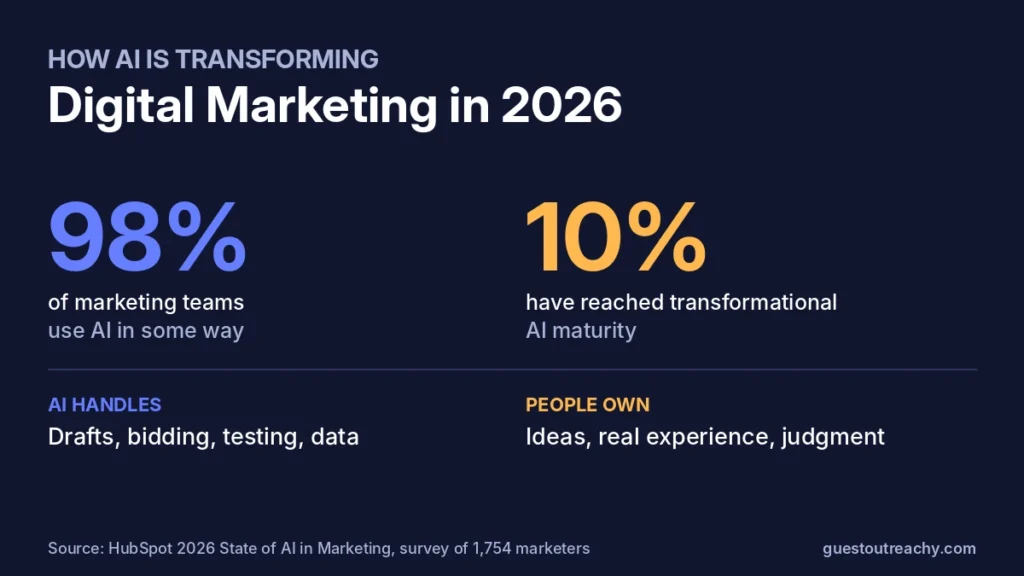
The numbers show how fast this moved. In the HubSpot 2026 State of AI in Marketing report, based on a survey of 1,754 marketers, 98 percent of marketing teams said they use AI in some way. The same research found that 80 percent of marketers use AI for content creation.
But using AI is not the same as using it well. The same report found that only about 10 percent of teams have reached what it calls transformational maturity. Most teams are still testing, not changing how they work.
Here is where AI shows up most in day to day marketing:
| Area | What AI does now | What still needs a person |
|---|---|---|
| Content | Outlines, first drafts, summaries, rewrites | The angle, real examples, the final edit |
| SEO | Keyword grouping, content briefs, audits at scale | Choosing which pages matter, judging intent |
| Paid ads | Bidding, targeting, testing headlines and images | Budget decisions, the offer, brand limits |
| Send times, subject line tests, segments | The message and when to stay quiet | |
| Analytics | Spotting trends and anomalies in data | Deciding what the numbers mean for the business |
| Social | Caption ideas, scheduling, reply drafts | Tone, timing on sensitive topics, community |
Where Machines Already Do Better
Some jobs are better done by software. Fighting that wastes time.
Speed with large amounts of data. Grouping five thousand keywords by topic, scanning a site for broken links or reading a year of campaign data takes a person days. A tool does it in minutes.
Testing many versions. AI can write twenty headline variations and help you test them. A person would usually stop at three.
Repetitive formatting. Meta descriptions for a hundred product pages, alt text drafts, report summaries. These are perfect jobs to hand off, as long as someone checks the result.
Pattern spotting. A sudden drop in clicks on one page, a spike in one country, an ad that stopped converting. AI is good at raising the flag early.
The common thread is volume. When a task is large, repetitive and easy to check, let the machine do it.
Jobs People Still Own
Now the other side. These are the parts of marketing where AI helps but cannot lead.
The idea. AI is trained on what already exists, so it is good at the average. A campaign that stands out needs an angle nobody has tried, and that still comes from people who know the customer.
Real experience. A tool can describe how to fix a slow website. It cannot say what happened when you fixed yours. First hand stories, screenshots and results are what make content trustworthy, and they come only from doing the work.
Taste and judgment. Knowing when a joke fits the brand, when a headline goes too far or when to say nothing at all is a human call.
Relationships. Outreach, partnerships and client trust are built between people. An AI written pitch that sounds like every other pitch gets ignored.
Accountability. When a campaign fails, someone has to understand why and own the fix. Software does not carry that responsibility.
You will find this same idea across marketing blogs, GrowthScribe among them: AI takes the workload, people keep the creative calls. The idea is right, but most posts stop there. The sections below show what it looks like in real work, from search and ads to the exact steps we follow.
Search Changed Too
AI did not only change how marketers work. It changed where customers find answers.
Google now answers many questions directly with AI Overviews and AI Mode. In October 2026, Google added more source links inside those answers and placed them higher, which means being cited has become a new kind of ranking.
What does that mean for your content? Pages that answer one clear question per section, show real proof and cover the follow up questions have the best chance of being picked as a source. Thin pages that repeat what everyone else says have very little chance.
Ads Run On Algorithms Now
Paid advertising has gone furthest down the AI path.
In April 2026, Google took AI Max for Search out of beta. It uses landing page content and real time intent to decide when your ad shows, and Google said it would move Dynamic Search Ads, automatically created assets and the campaign level broad match setting over to AI Max by the end of September 2026. Meta has pushed advertisers the same way with its Advantage+ campaigns.
The result is that much of the manual work in ads, such as choosing keywords and setting bids, is now handled by the platform. The work that is left is the work that matters most:
- A clear offer people want
- Landing pages that match what the ad promises
- Clean conversion tracking, so the algorithm learns from the right signals
- Brand limits that stop the system from showing ads in the wrong places
Google Rules For Automated Content
A common worry is that Google punishes anything written with AI. It does not.
In its guidance on AI generated content, Google says it focuses on the quality of content, not on how it was produced. The same post is clear about the limit: using automation, including AI, to create content mainly to manipulate search rankings breaks its spam policies.
Google also suggests asking three questions about any page. Who created it? How was it created? Why was it created? If the honest answer to the last one is to help people, you are on the right side.
Inside Our Workflow
Here is how our team uses AI on a typical article or client project:
- We decide the topic and angle ourselves, based on real search data and what clients ask us.
- We use AI tools for research support and a first structure. It saves hours on the blank page.
- We check every fact against its original source, such as Google documentation or the help page of the tool. If we cannot verify a number, it does not go in.
- We add what only we have: our own screenshots, results from our own site and lessons from client work.
- A person edits the final version for voice, accuracy and anything that sounds generic.
The rule we follow is simple. AI can help us work faster, but it never gets the last word.
Mistakes Teams Make
- Publishing first drafts. AI drafts sound fluent but often say very little. Unedited, they read like everything else on the topic.
- Trusting numbers without checking. AI tools can state wrong statistics with full confidence. Every figure needs a source you have opened yourself.
- Producing at scale for its own sake. Hundreds of thin pages can fall under the scaled content abuse rules in Google spam policies.
- Letting ad platforms run without limits. Automated campaigns still need clear goals, clean tracking and brand rules.
- Removing the human voice. Readers can tell when nobody is behind the words, and they leave.
FAQ
How is AI transforming digital marketing?
It handles data heavy and repetitive tasks such as drafting, bidding, testing and analysis, while people focus on strategy, ideas and real experience.
Will AI replace digital marketers?
It is replacing tasks, not the people who know how to direct them. Marketers who can brief, check and improve AI output are becoming more valuable.
Does Google penalize AI written content?
No, not by itself. Google rewards helpful content however it is made, but content created mainly to manipulate rankings breaks its spam policies.
What marketing jobs still need humans?
Strategy, creative ideas, first hand experience, relationships and final judgment on what goes live.
How should a small business start using AI in marketing?
Start with one repetitive task, such as drafting meta descriptions or summarizing reports, check every result, and expand only when the quality holds.
Conclusion
AI has changed digital marketing for good. It writes faster, tests more and reads data better than any team could alone.
What it has not changed is why people buy. They still respond to a clear idea, real proof and a brand they trust, and those still come from people.
So let the machines carry the volume, keep the thinking human and check everything before it goes live. That balance is how AI is transforming digital marketing for the teams doing it well.