
By Guest Outreachy Team
Google spam update recovery starts with one uncomfortable fact. There is no reset button, no form that restores rankings after an automated demotion and no fixed waiting period. Google says a site that fixes its problems may improve once its systems learn over a period of months that the site now follows the rules. Everything you do in between decides whether that day comes.
2026 has been a heavy year for spam enforcement. Google ran four spam updates, the last one ending on October 8 after almost two weeks. Policy shifts added more confusion, such as the EEA site reputation split that changed how manual actions apply in Europe, and risks from old placements, such as a guest post after the site is sold to a new owner who fills it with spam.
This guide walks you through confirming the cause, finding the policy you broke, fixing it properly and setting honest expectations for the months ahead.
Table of Contents
2026 Updates at a Glance
Start by lining up your traffic drop against these dates from the Google Search Status Dashboard.
| Update | Start date | Rollout length | Notes |
|---|---|---|---|
| March 2026 spam update | March 24 | 19 hours, 30 minutes | Followed three days later by the March core update |
| June 2026 spam update | June 24 | 2 days, 1 hour | Came about three weeks after the May core update finished |
| August 2026 spam update | August 18 | 2 days, 16 hours | Global rollout |
| September 2026 spam update | September 24 | 13 days, 16 hours | Ended October 8, applied globally and to all languages |
Google described the September rollout as a normal spam update with nothing new beyond running it again, according to Search Engine Land. Observers such as Lily Ray and Glenn Gabe reported early drops on templated, programmatic and mass produced AI pages, but Google did not name a target, so treat those reports as patterns, not rules.
Two core updates also ran in 2026, starting March 27 and May 21. If your drop sits near one of those dates, the cause may be content quality, not spam, and the fix is different.
Confirm the Cause First
Many sites blame a spam update for a drop that came from somewhere else. Rule out the other causes before you change anything.
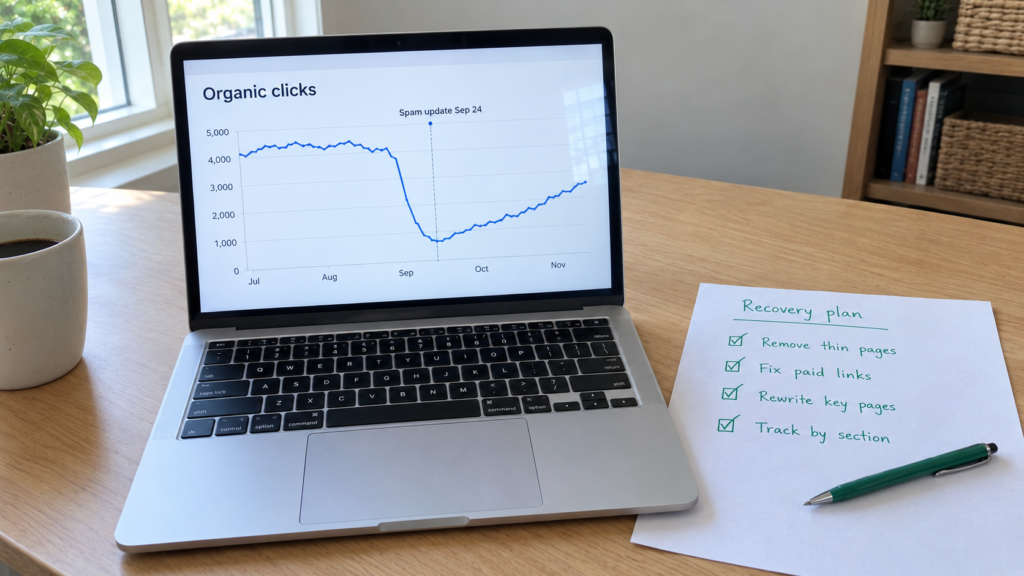
- Match the dates. Plot daily clicks in Search Console and mark the update start and end dates. A drop that starts weeks before or after the window points elsewhere.
- Check the Manual actions report. If it lists an action, you are dealing with a human review, which has its own route below.
- Rule out technical damage. Test key pages in URL Inspection. Look for a noindex tag, a robots.txt block, server errors or a broken redirect added near the drop date.
- Split brand from non brand queries. A fall in brand searches usually means lower demand, not a penalty.
- Check seasonality. Compare the same weeks last year before you assume a penalty.
- Segment by folder and template. Spam systems often hit one section, such as a programmatic directory or a block of guest posts, while the rest of the site holds.
If the drop matches an update window, sits in specific sections and has no technical explanation, a spam system is the likely cause.
Automated Demotion or Human Review
The two outcomes look similar in traffic charts but need different handling.
| Point | Algorithmic demotion | Manual action |
|---|---|---|
| How you find out | No message, only a drop that lines up with an update | Message in the Manual actions report and the Search Console inbox |
| Who decides | Automated systems such as SpamBrain | A human reviewer at Google |
| How to exit | Fix the problem, then wait for systems to reassess | Fix every affected page, then send a reconsideration request |
| Typical wait | Months, according to Google | Several days or weeks for the review, per Google, then time to regain ground |
Policy Areas to Audit
Google lists its spam practices on its spam policies page. These are the areas most sites trip over, with what to look for on your own pages.
- Scaled content abuse. Large numbers of pages made mainly to rank, with little value for readers, no matter whether a person, a template or an AI tool created them. Look for city or keyword swap pages, thin AI drafts published in bulk and pages nobody visits.
- Site reputation abuse. Third party content hosted mainly to borrow your site ranking strength, such as unrelated coupon, casino or affiliate sections with little oversight. Look for sections written by outsiders on topics far from your core.
- Expired domain abuse. Buying an old domain and filling it with unrelated content to ride its past reputation.
- Link spam. Paid links without a sponsored tag, link exchanges, networks and keyword stuffed anchors in guest posts.
- Cloaking, hidden text and sneaky redirects. Content shown to Google that differs from what users see.
- Doorway pages. Many similar pages that funnel users to one destination.
Score each section of your site against this list. Most hit sites find one or two clear problems, not ten.
Google Spam Update Recovery Plan
Work through these steps in order and log every change with a date.
- Stop the tactic. Pause any bulk publishing, link buying or third party content deals tied to the problem.
- Remove or improve the worst pages. Delete or noindex thin scaled pages that have no real readers. Merge near duplicates into one strong page and redirect the rest.
- Rewrite pages worth keeping. Add first hand detail, original data, clear authorship and a reason to exist beyond ranking.
- Clean up links you built. Ask sites to remove paid or exchanged links or add rel sponsored. Use the disavow tool only for links you could not remove, and mainly when a manual action names unnatural links.
- Separate or drop third party sections. If outsiders write content far from your topic, bring it under real editorial control or remove it.
- Fix technical spam signals. Remove hidden text, cloaking and redirects that send users somewhere unexpected.
- Publish helpful content steadily. New pages built for readers show the systems what the site is now about.
- Measure by section. Track clicks for each folder or template you changed, not only the sitewide total.
Make changes in clear batches. If you change everything at once, you cannot tell what worked.
Manual Action Route
A manual action needs a full fix before you ask for review. The Google help page on the Manual actions report is direct about this: fixing the issue on only some pages will not earn a partial return.
For unnatural links, Google asks you to download your links, contact site owners to remove them or add nofollow, and use the disavow tool only for links you could not remove. It warns that disavowing everything without trying removal might lead to a rejected request.
A good reconsideration request explains the exact issue, the steps you took and the documented outcome. Google says most reviews take several days or weeks, and it emails you when the review starts and ends. Do not send a new request while one is pending.
Honest Timelines
The Google page on spam updates says a site may improve if its systems learn over a period of months that the site complies with the policies. John Mueller added in September 2026 that fixing issues around bigger algorithmic changes can take many months before effects show.
There is also a hard limit for link spam. Google says that once its systems neutralize spammy links, any ranking benefit those links gave cannot be regained, and that changes may not bring an improvement. A site that ranked on bought links should expect a new, lower baseline and build from there.
Plan your reporting in quarters, not weeks. Early signs often show first in impressions for the sections you fixed.
Moves That Delay Progress
- Mass deleting good pages in panic. Removing strong pages with real readers takes away the content you need to recover.
- Swapping one tactic for another. Moving from bought links to a private network repeats the same problem.
- Disavowing thousands of links from a tool report. It rarely helps an algorithmic content issue and can discard good links.
- Buying a guaranteed recovery package. No one outside Google can promise a timeline.
- Changing domains to escape. Redirecting a hit site to a new domain can pass the problem along, and the new domain starts with no track record.
Questions Readers Ask
How long does recovery from a spam update take?
Google says improvement may come once its systems learn over months that a site complies. There is no fixed date.
Do I need to wait for the next spam update to recover?
Not always. Google says its spam detection systems run all the time, so improvements can appear between named updates.
Will a reconsideration request help after an algorithmic drop?
No. Reconsideration requests only apply to manual actions shown in the Manual actions report.
Can I recover rankings that came from paid links?
No. Google says the benefit from neutralized spammy links cannot be regained.
Should I delete AI generated content?
Not because AI wrote it. Google judges whether pages are made mainly to manipulate rankings with little value. Remove or improve the thin pages, whoever wrote them.
Conclusion: Patience Backed by Proof
Google spam update recovery follows a clear order. Confirm the drop matches an update window and is not technical or seasonal, check for a manual action, find the policy area you broke, fix it fully and document every change. Manual actions need a complete fix and a reconsideration request. Algorithmic drops need clean pages and months of patience.
The sites that recover are the ones that stop the tactic for good, rebuild around readers and measure progress section by section, not the ones searching for a quick reversal.