
By Guest Outreachy Team
Toxic backlinks is a label from SEO tools, not from Google. It describes links that a tool thinks could harm your rankings, and it often turns a calm backlink report into a wall of red warnings. Some of those warnings matter. Most do not, and treating every one as a threat wastes hours and can push you into cleanup work that harms good links.
The difference comes down to who created the link and why. A link you bought on a guest post marketplace without a sponsored tag is a real risk. A random scraper site that copied your page is not. Metrics such as those compared in our guide on Ahrefs DR vs Moz DA cannot tell you which is which, because neither score measures intent.
This guide shows you where the label came from, which signals deserve attention, which ones are noise and a short audit method that sorts your links into clear buckets.
Table of Contents
Where Toxic Backlinks Came From
Google uses the term link spam. Its spam policies, last updated on August 28, 2026, define it as creating links to or from a site mainly to manipulate rankings. The word toxic does not appear in that policy.
The toxic label grew out of backlink audit tools that score links with their own formulas. John Mueller has said several times that these scores do not reflect how Google treats links. In 2022 he wrote that disavowing random links that look weird or that a tool has flagged is not a good use of time and changes nothing, as Search Engine Journal reported. In April 2025 he went further and said Google has no internal notion of toxic backlinks at all.
So the useful question is never whether a link is toxic. It is whether the link is part of a scheme you or someone working for you took part in.
Signals That Deserve Attention
These patterns match examples in the Google link spam policy. If you find them, they are worth a closer look.
| Signal | Why it matters | Who usually created it |
|---|---|---|
| Paid links without rel sponsored or nofollow | Buying links that pass ranking credit is the first example in the Google policy | You, an agency or a vendor |
| Guest posts with exact match commercial anchors | Google lists keyword optimized anchors in guest posts and press releases as link spam | You or a vendor |
| Excessive link exchanges or partner pages | Swapping links mainly for cross linking breaks the policy | You |
| Links from automated programs or services | Bulk tools that create links are listed by name | You or a cheap service |
| Sitewide footer or template links across many unrelated sites | Widely distributed template links are a named example | Usually a vendor or theme deal |
| Low quality directory or bookmark links | Named in the policy | You or an old SEO provider |
| Widgets with hidden or keyword rich links | Named in the policy | You, through a widget you shared |
Notice the last column. Almost every real risk traces back to a decision someone on your side made.
Noise Worth Ignoring
These links trigger warnings in many tools but rarely need action:
- Scraper and copy sites. They repost your content with your links intact, and you had no part in it.
- Spam directories you never submitted to. They list thousands of sites automatically.
- Foreign language links from unrelated sites. Mueller said in 2025 that random foreign links are typically not harmful and that Google works to ignore them.
- Low DR or low DA domains. A small but real blog with a low score is not a threat. Authority scores measure link popularity, not trust.
- Links that appear and vanish in clusters. Automated spam waves come and go without your input.
If you did not ask for it, pay for it or trade for it, it is usually noise.
Three Bucket Audit
Use this method once a quarter or after any link campaign. It takes an afternoon for most small and mid sized sites.
- Export your links. Pull the external links report from Search Console, then add data from one backlink tool for wider coverage.
- Sort by referring domain. Work with domains, not single URLs, so the list stays manageable.
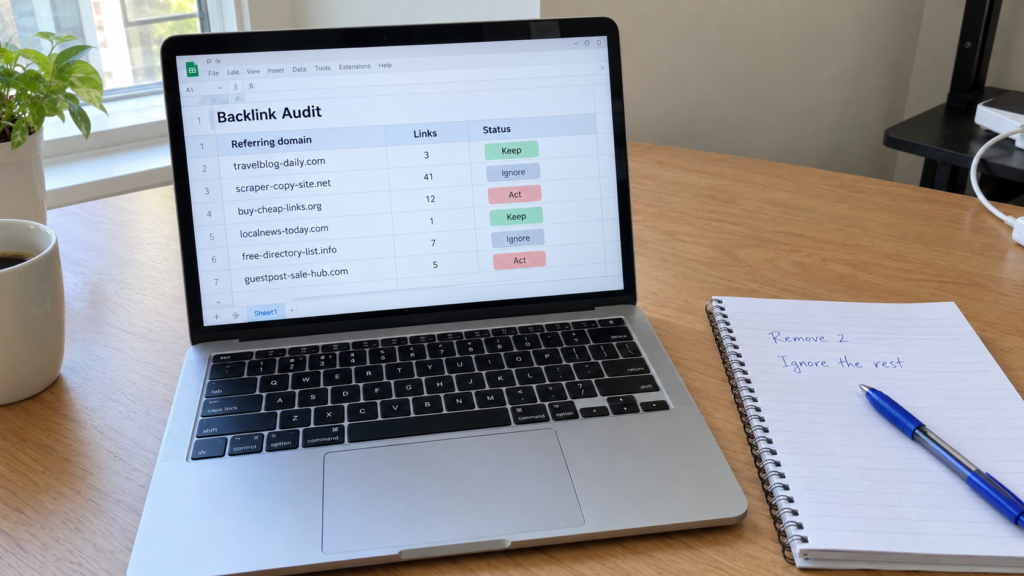
- Place each domain in one bucket.
- Keep: real sites with real readers, whatever their score.
- Ignore: scrapers, auto directories and random spam you never touched.
- Act: paid, exchanged or network links, and guest posts with commercial anchors and no sponsored tag.
- Work the Act bucket only. Ask each site owner to remove the link or add rel sponsored or nofollow. Keep a dated log of every request and reply.
- Decide on the disavow tool last. Consider it only for links in the Act bucket that you could not remove, and mainly if Search Console shows a manual action for unnatural links.
- Record the result. Note the date and the counts per bucket, so the next audit takes minutes.
Most sites end the audit with a tiny Act bucket, or an empty one. That is a good outcome, not a sign that you missed something.
When Guest Posts Get Flagged
Semrush lists 45 toxic markers in its Backlink Audit tool, grouped into link networks, community spam, harmful environment, manipulative links, irrelevant sources and smaller signals. Guest post link, author link, money anchor text and sitewide link all sit in the manipulative group.
That means an honest guest post on a respected site can be flagged only because it has an author bio link. The marker describes the format, not the intent. Before you act, check three things: whether money changed hands, whether the anchor was an exact match commercial phrase and whether the host site has real readers in your topic.
A guest post written for the audience, with a natural anchor and an editor who chose to publish it, belongs in the Keep bucket. A paid placement on a site that sells posts to anyone, with an exact match anchor and no sponsored tag, belongs in the Act bucket.
Reading Tool Scores Correctly
Tool scores are useful as a sorting aid. They are a poor judge on their own.
The Semrush help page for Backlink Audit says its overall toxicity score is high when more than 10 percent of your backlinks are toxic, medium between 3 and 9 percent and low below 3 percent. The score updates after you confirm a disavow, which can tempt site owners to disavow just to see the number fall. A lower number in a third party tool changes nothing in Google.
Other tools use different formulas and labels, so the same link can be green in one tool and red in another. Use the score to decide where to look first. Use the signals table above to decide what to do.
Outcomes Once Google Spots Them
Google handles most link spam with automated systems. Its page on spam updates explains that when those systems neutralize spammy links, any ranking benefit the links produced cannot be regained. In practice, a bought link usually stops helping before it starts hurting.
A manual action is the more serious outcome. It appears in the Manual actions report in Search Console as unnatural links to your site. Google then asks you to remove the links you can, disavow the rest and send a reconsideration request with documentation.
Spam updates add pressure on top. In 2026 Google released spam updates in March, June, August and September, and the September rollout took almost two weeks, ending on October 8.
Prevention for Future Campaigns
- Ask every vendor whether the placement is paid, and require rel sponsored when it is.
- Ban exact match commercial anchors in guest posts. Use your brand, the article title or a natural phrase.
- Vet host sites for real organic traffic and a real readership in your topic, not only for DR or DA.
- Avoid sites that publish posts on every topic for anyone who pays.
- Keep a placement log with the URL, date, anchor, cost and contact for each link.
These five habits keep the Act bucket empty, which saves far more time than any cleanup.
Questions Readers Ask
Does Google penalize toxic backlinks?
Google does not use that term. It acts on link spam, mainly links you bought, exchanged or built with automated tools. Random spam links are usually ignored.
Should I disavow every link my SEO tool marks as toxic?
No. Mueller has said disavowing links only because a tool flagged them is not a good use of time. Act only on links tied to a scheme.
Can a competitor hurt me with spammy links?
Mueller has said many times that Google works to ignore random links pointing at a site, so negative SEO attacks rarely explain a ranking drop.
How often should I check my backlinks?
Once a quarter is enough for most sites, plus a check after any paid or outsourced link campaign.
Are low DR links toxic?
No. A low score only means the site has few strong links. A small real blog in your niche is a healthy link.
Conclusion: Judge Intent, Not Numbers
Toxic backlinks is a tool label, while Google judges link spam by intent and pattern. Paid links without a sponsored tag, keyword stuffed guest post anchors, exchanges, networks and automated links deserve action. Scrapers, random spam and low score sites usually do not. Sort your links into Keep, Ignore and Act, work only the Act bucket, try removal before anything else and treat tool scores as a guide to where to look, never as a verdict.
The strongest protection is upstream. Vet every placement, ask for sponsored tags on paid links and keep a log, and your next audit will be short.