
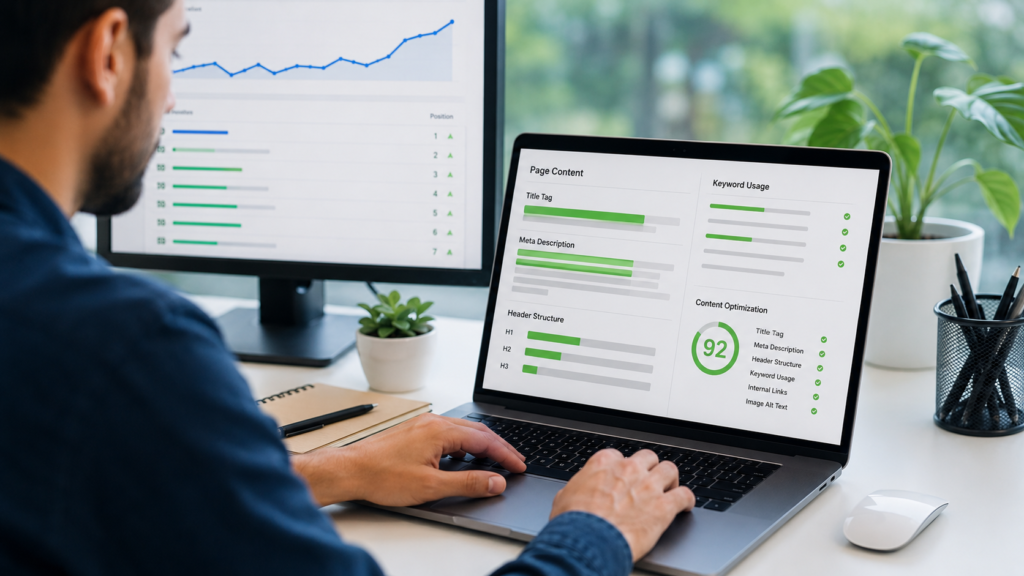
Ranking well on Google depends on far more than publishing content and hoping for the best. Search engines evaluate dozens of signals on every single page before deciding where it deserves to appear in results. This is exactly the work that this kind of optimization focuses on. They take the pieces of a website that can be directly controlled and optimize each one so search engines and readers both understand the page clearly.
This article breaks down what these services actually involve. It explains why businesses invest in them. It also covers how to choose a provider and what trends are shaping this corner of SEO right now.
What Is On Page SEO
On page SEO refers to every optimization technique applied directly within a website. This includes content quality. It includes title tags meta descriptions header structure internal links and technical elements like page speed and mobile responsiveness. Unlike off page SEO which deals with backlinks and external signals on page work is entirely within a business own control.
The Google Search Central SEO documentation explains that helping search engines understand your content clearly is one of the most important steps toward better visibility. That principle sits at the core of every on page optimization decision. A page can only rank as well as it is understood. If the content structure or technical setup confuses search engines the page suffers regardless of how good the underlying writing might be.
What Do On Page SEO Services Include
Keyword and Content Optimization
This is usually where the work begins. A provider researches which terms real people search for around a topic. They then align the page content with that language naturally rather than forcing keywords in awkward places. The goal is content that reads well for humans while still signaling clear topical relevance to search engines.
Content depth also falls under this category. Thin pages that barely touch a topic tend to underperform compared to pages that thoroughly answer the questions a searcher actually has. Skilled providers expand content strategically. They add genuinely useful sections rather than padding a page with filler text just to hit a word count.
Title Tags and Meta Description Optimization
Title tags and meta descriptions are often the very first thing a potential visitor sees in search results. A well written title tag communicates exactly what the page offers while naturally including the target keyword near the beginning. According to Moz beginner resources on SEO fundamentals title tags remain one of the strongest on page ranking signals available to site owners today.
Meta descriptions do not directly influence rankings the same way title tags do but they play a major role in click through rate. A compelling description that clearly states the page value can meaningfully increase how many searchers choose to click a result even when it does not rank in the very top position.
Header Structure and Internal Linking
Proper header structure helps both readers and search engines scan a page efficiently. A single clear H1 followed by logically nested H2 and H3 headings makes content easier to skim while also helping search engines understand how different sections relate to one another.
Internal linking connects related pages across a website in a way that distributes authority and helps visitors discover more relevant content. A thoughtful internal linking strategy often surfaces older valuable pages that would otherwise be buried deep within a site and rarely found by new visitors.
Image and Technical Element Optimization
Images need proper file names alt text and compression to load quickly without sacrificing visual quality. Poorly optimized images are a common reason pages load slowly which directly hurts both user experience and search rankings.
Technical elements like clean URL structure proper canonical tags and mobile responsiveness round out this category. These pieces rarely get noticed by casual visitors yet they quietly determine whether a page performs well across devices and search conditions.
Page speed deserves particular emphasis within this category since it directly affects both user experience and rankings. Slow loading pages tend to see higher bounce rates as visitors leave before content even finishes rendering. Providers working on this piece often focus on compressing images reducing unnecessary scripts and streamlining how a page loads its core content first before less critical elements.
Why Businesses Need Professional Support in This Area
Many business owners assume on page optimization is simple enough to handle without outside help. In reality it requires ongoing attention to detail combined with deep familiarity with how search engines evaluate content. A single overlooked technical issue can undermine months of otherwise strong content work.
Professional providers also bring pattern recognition built from working across many websites and industries. They can quickly identify what is holding a page back based on experience rather than starting from scratch through trial and error. This kind of efficiency often saves businesses significant time compared to attempting every optimization internally without dedicated expertise.
There is also the simple matter of bandwidth. Internal marketing teams are frequently stretched across many priorities at once. Bringing in specialized support for on page work allows a business to maintain consistent optimization across its entire site rather than treating SEO as an occasional afterthought squeezed between other tasks.
Cost effectiveness often surprises business owners who assume professional support must be expensive. When measured against the value of consistent organic traffic that keeps generating leads month after month without ongoing ad spend the investment frequently pays for itself many times over across a reasonable time horizon.
How On Page SEO Services Work Step by Step
The process typically begins with a full audit of existing pages. This reveals which pages already perform reasonably well and simply need refinement versus which pages have deeper structural or content issues that require a more thorough rebuild.
This audit phase often examines a wide range of signals at once. It looks at current keyword rankings organic traffic trends and how competitor pages are structured for the same target terms. It also reviews technical health including crawl errors broken links and page speed scores. Combining all of these signals gives a clear starting picture rather than optimizing based on guesswork alone.
From there providers usually prioritize pages based on potential impact. High traffic pages sitting just outside the top rankings often receive attention first since relatively small improvements there can produce meaningful traffic gains quickly. Newer or lower priority pages get folded into the plan over subsequent weeks.
Implementation follows next including content updates title and meta rewrites header restructuring and any necessary technical fixes. Most reputable providers then monitor rankings and traffic over the following weeks to confirm the changes are producing the intended results and adjust further where needed.
What to Look for When Choosing an On Page SEO Provider
Experience across your specific industry can matter significantly since search behavior and competitive dynamics vary widely between sectors. A provider familiar with your niche often identifies opportunities faster than one starting completely fresh.
Transparency around process and reporting is equally important. A trustworthy provider should be able to clearly explain what changes they are making and why rather than treating their work as a black box. Regular reporting that ties optimization work back to actual traffic and ranking movement helps confirm the investment is producing real results.
It is also worth asking how a provider handles ongoing algorithm changes. Search engines update their systems constantly and a provider who stays current with these shifts is far more likely to deliver sustained results compared to one relying on outdated tactics that may no longer align with how modern rankings actually work.
Pricing structure deserves attention as well. Some providers charge a flat monthly retainer while others price based on the number of pages or hours involved. Neither model is inherently better but understanding exactly what is included helps avoid surprises later. A clear scope of work outlined before any agreement begins tends to produce a much smoother working relationship than a vague arrangement that leaves expectations open to interpretation.
Reviews Comparing DIY Versus Professional Support
Handling on page optimization independently can work reasonably well for very small websites with limited pages and low competition. Free tools and educational resources make it possible to apply basic best practices without significant financial investment.
For larger or more competitive websites the calculation shifts considerably. Business owners attempting to manage on page work alongside every other operational responsibility often find that optimization gets deprioritized whenever things get busy. This inconsistency tends to produce far weaker results than a dedicated ongoing effort managed by specialists who treat this work as their primary focus rather than a secondary task.
Many businesses ultimately land on a hybrid approach. They handle simple day to day content updates internally while relying on professional support for deeper technical work and strategic direction. This balance often delivers strong results without requiring a business to fully outsource every piece of its content operation.
Choosing where to draw that line usually comes down to available internal expertise and the competitiveness of the market involved. A niche with relatively low competition might only need occasional professional guidance layered on top of solid internal habits. A crowded competitive space typically demands a more consistent professional presence to keep pace with rivals who are also actively investing in their own optimization efforts.
Common Mistakes Businesses Make Without Expert Help
Keyword stuffing remains a surprisingly common issue even though most search engines have long since stopped rewarding it. Pages crammed with unnatural repetition of a target phrase tend to read poorly for actual visitors and can even trigger quality penalties in some cases.
Neglecting mobile optimization is another frequent oversight. With the majority of searches now happening on mobile devices a page that renders poorly or loads slowly on a phone will struggle regardless of how strong its written content might be.
Duplicate or near duplicate content across multiple pages also causes ongoing confusion for search engines trying to determine which version deserves to rank. Businesses without dedicated SEO oversight often accumulate this kind of overlap gradually over time without realizing the cumulative impact it has on overall site performance.
Industries That Benefit Most From This Work
Ecommerce sites tend to see some of the largest gains from dedicated on page attention simply because of scale. A store with hundreds or thousands of product pages faces constant risk of thin duplicate or poorly structured content across its catalog. Systematic optimization applied consistently across that volume often produces meaningful traffic and revenue improvements that would be difficult to achieve through occasional manual fixes.
Local service businesses also benefit significantly since location specific pages need careful attention to remain distinct and relevant for each area served. Professional services and healthcare providers face similar demands given how much trust and accuracy matters within their content. Across nearly every industry the underlying principle stays the same. Pages that clearly and thoroughly address what a searcher actually needs consistently outperform pages built without that level of care.
Latest Trends Shaping This Field
AI generated search summaries have pushed providers to focus even more heavily on content clarity and structure. Pages that directly and thoroughly answer specific questions in an organized format have a stronger chance of being referenced within these AI generated results rather than simply competing for a traditional ranking position.
Core Web Vitals and overall page experience metrics continue gaining weight as ranking considerations. Providers increasingly treat speed and interactivity improvements as inseparable from traditional content optimization rather than a separate technical afterthought handled by a different team entirely.
There is also growing emphasis on demonstrating genuine expertise and firsthand experience within content itself. Search engines have become noticeably better at distinguishing between generic templated writing and content that reflects real depth of knowledge which has raised the bar for what counts as strong on page work. Providers who understand this shift are adjusting their process accordingly rather than relying on outdated formulas that once worked but no longer reflect how modern search evaluation actually functions. For businesses looking to build this kind of depth across their site working with an experienced SEO services team can help ensure every page reflects the expertise search engines and readers both expect.
Frequently Asked Questions
What is included in this type of service?
These services typically include keyword research content optimization title tag and meta description writing header structuring internal linking and technical fixes related to speed and mobile usability.
How much does this kind of support usually cost?
Pricing varies widely based on website size and competitiveness. Small business packages often start in the low hundreds per month while larger enterprise engagements can run considerably higher depending on scope.
How long does it take to see results?
Most businesses begin noticing measurable improvements within two to four months. Highly competitive industries or larger sites with more pages to optimize may take longer to show significant ranking movement.
Can I do on page SEO myself instead of hiring a provider?
Yes for smaller sites with limited competition basic on page work is achievable independently. Larger or more competitive sites generally benefit from professional expertise to manage the ongoing complexity effectively.
Is on page SEO a one time project or an ongoing service?
It works best as an ongoing service. Search engines update their algorithms regularly and competitor pages continue evolving which means optimization needs periodic review rather than a single initial pass.
What is the difference between on page and technical SEO?
On page SEO generally focuses on content and visible page elements while technical SEO covers underlying site infrastructure like crawlability indexing and site architecture. Many providers handle both together since they are closely connected.
Does this kind of support include content writing?
Many providers do include content creation or rewriting as part of their service since strong content sits at the center of effective on page work. Some businesses prefer keeping writing internal while outsourcing structural and technical optimization.
How do I know if this kind of support is actually working?
Track organic traffic keyword ranking movement and click through rate over time rather than relying on a single metric. Consistent upward movement across these signals over several months indicates the work is producing genuine results.
Conclusion
On page SEO services address the parts of a website that are entirely within a business control. These elements often go underutilized without dedicated expertise. From content and keyword alignment to technical structure and page experience every element covered by this work contributes directly to how well a site performs in search results.
Businesses that invest consistently in this area tend to build stronger long term visibility compared to those treating optimization as an occasional afterthought. The compounding nature of strong on page work means early investment often continues paying dividends well beyond the initial optimization period. If you want expert support building out a comprehensive on page strategy for your website our digital marketing services team can help you turn these principles into measurable growth.
Pingback: How to Insert a Link in Word, Excel and HTML 2026