
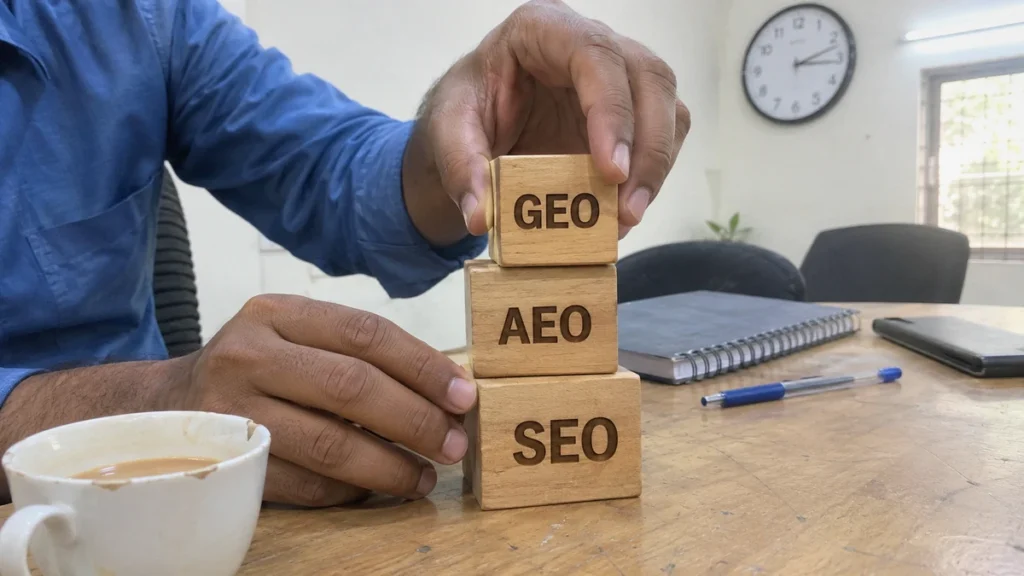
GEO vs SEO vs AEO comes down to where your page shows up. SEO gets your page ranked in Google, AEO gets it picked as the direct answer, and GEO gets it quoted inside AI answers from ChatGPT, Gemini, Perplexity and Google AI Mode. All three stand on the same base, and Google itself says AI optimization is still SEO. For the hands on side, see how to get your site cited in Google AI Mode and what the new Search Console AI report can show you.
Quick answer
- SEO (Search Engine Optimization): rank in the normal Google and Bing results and earn the click.
- AEO (Answer Engine Optimization): be the one short answer in a featured snippet, a voice assistant or an AI box.
- GEO (Generative Engine Optimization): be named or cited when an AI tool writes a longer answer.
- Which first? SEO. Google says its AI features pull pages from its normal search index, so a page Google has not indexed cannot be cited.
Table of Contents
SEO, AEO and GEO at a Glance
| Point | SEO | AEO | GEO |
|---|---|---|---|
| Full form | Search Engine Optimization | Answer Engine Optimization | Generative Engine Optimization |
| Goal | Rank and get the click | Be the single direct answer | Be named or cited in an AI written answer |
| Where it shows | Google and Bing results | Featured snippets, voice assistants, AI answer boxes | ChatGPT, Gemini, Perplexity, Copilot, Google AI Overviews and AI Mode |
| What the searcher does | Clicks your link | Reads or hears your answer, often without a click | Reads a summary that may name or link your brand |
| What helps | Relevant content, crawlable pages, links | Clear question headings with a short answer under each | Original facts, sources, quotes and real mentions of your brand on other sites |
| How to measure | Search Console clicks and positions | Checking who holds the answer box for your questions | Search Console Generative AI report, Bing AI Performance report, referral visits from AI tools |
What Is AI SEO Called Now?
AI SEO has no single official name. People use four labels for nearly the same work, and that is why searches like ai seo is called geo and is ai seo called aeo keep showing up in Google suggestions.
- GEO, Generative Engine Optimization. The name comes from a research paper by a team from Princeton University and IIT Delhi, first posted in November 2023 and accepted to KDD 2024. It is the label with a real research origin.
- AEO, Answer Engine Optimization. Older than ChatGPT. It started with featured snippets and voice assistants. Marketer Jason Barnard says he coined it in 2017, though that claim comes from his own site.
- AIO, AI Optimization. A broad label for the same idea. Be careful, because AIO is also short for Google AI Overviews, so the same three letters can mean two different things.
- LLMO, Large Language Model Optimization. Used for tools such as ChatGPT and Claude that run on large language models.
So is AI SEO called GEO? Yes, GEO is the name with the research behind it, and AEO is the older name for the short answer side of the same job. Google does not use either label. Its July 2026 guide calls the whole thing SEO.
Why People Are Searching GEO vs SEO vs AEO in 2026
People search this because AI answers now sit above the normal results, and they want to know if their old SEO still counts. We checked it ourselves before writing.
What our own search check found (11 November 2026). We pulled Google search suggestions and related searches in the US, UK, India, Pakistan and Australia. These questions came up across them:
- ai seo is called geo
- is ai seo called aeo
- geo vs seo vs aeo vs aio
- aeo vs seo full form
- geo vs seo 2026
- aeo and geo certification
In Google Trends for the last 12 months worldwide, geo vs seo scored an average of 6, aeo vs seo scored 4 and guest posting sites scored 3. Trends numbers are relative, not search counts, but they show the new terms are now searched more than an established SEO topic. Pakistan ranked fourth among countries for geo vs seo.
The numbers behind the interest:
- AI Overviews on over 80% of searches. Search Engine Roundtable reported in October 2026 that trackers from Semrush, SE Ranking and seoClarity now see AI Overviews on more than 80% of the searches they follow.
- 900 million weekly ChatGPT users. OpenAI shared this figure in February 2026, as reported by TechCrunch.
- Ranking in the top 10 is no longer enough on its own. An Ahrefs study of 863,000 keywords, published in March 2026, found only 38% of AI Overview citations came from pages in the top 10, down from about 76% in July 2025. About 31% came from pages outside the top 100.
That last point explains the whole debate. Google says its AI features use query fan out, which means the AI runs several related searches at once and cites pages that rank for those smaller questions too. Your page can be cited for a question you never targeted, or skipped for the one you rank first on.
SEO: Still the Base Layer
SEO is the work of getting your pages crawled, understood and ranked in search results. It still matters first because Google says its AI Overviews and AI Mode pull pages from the same index and core ranking systems as normal search.
SEO has four parts, which also answers the common question about the four types of SEO:
- On page SEO: the words, headings, titles and internal links on each page. Our guide to on page SEO services covers what this work includes.
- Technical SEO: crawling, indexing, speed and a clean site structure.
- Off page SEO: links and mentions from other websites.
- Local SEO: your Google Business Profile, reviews and local pages.
Example: a bakery in Karachi ranks third for birthday cakes Karachi. A searcher sees the blue link, clicks it and orders. That click is the SEO win.
AEO: Becoming the Direct Answer
AEO means shaping a page so a search engine or assistant can lift one clear answer from it. The answer shows as a featured snippet, a spoken reply from a voice assistant or a short line in an AI box.
What it takes:
- A heading written as the exact question people type
- The answer in the first one or two sentences under that heading
- Details, steps or exceptions after the answer, not before it
- One question per heading, so the answer is easy to find
Google says no special schema is needed for its AI features, so AEO is about clear writing, not extra code.
Example: someone asks how long a new guest post takes to show in Google. A page with that question as a heading and a two line answer under it has a fair chance of being the answer read out. A page that hides the answer in paragraph six does not.
GEO: Getting Cited Inside AI Answers
GEO means making your page and your brand the source an AI tool trusts enough to quote, name or link when it writes a full answer. The answer is longer than a snippet and can mix several sources.
The Princeton and IIT Delhi paper tested changes to web pages and measured how visible each source became in the AI answer. Against the plain version of a page:
- Adding quotations from relevant people raised visibility by about 41%
- Adding statistics raised it by about 31%
- Citing sources raised it by about 27%
- Keyword stuffing lowered it by about 8%, one more reason to avoid the black hat SEO tactics that also hurt rankings
These are lab results on the AI engines the team tested, so treat them as direction, not a promise. They match what Google asks for anyway: original, people first content with real facts.
GEO also reaches beyond your own site. AI tools read reviews, forums, news and other blogs, so real mentions of your brand on relevant sites help, including unlinked brand mentions where your name appears without a link. Google adds a warning here: seeking inauthentic mentions across the web is not as helpful as it might seem.
Example: a buyer asks ChatGPT which guest posting agencies in Pakistan work directly with site owners. The tool can only name a business that appears on pages it can find and trust, such as its own clear service page, client reviews and articles on other relevant sites.
Is AEO Part of GEO?
They overlap, and in practice AEO is the short answer part of GEO. AEO aims for one direct answer. GEO aims to be one of the sources behind a longer answer. A page with clear question headings, short answers and real data can win both, and both still depend on the page being indexed and ranked first, which is SEO.
What Google Says You Do Not Need
Google answered the GEO question in its own guide to generative AI features on Google Search, last updated on 10 July 2026. It says optimizing for generative AI search is still SEO, and it lists things you can skip:
- llms.txt and AI text files. You do not need new machine readable files, AI text files or Markdown pages, and Google Search ignores them.
- Chopping content into tiny pieces. There is no need to break pages into small chunks for AI.
- Writing in a special AI style. You do not need to write in a certain way for AI search.
- Special schema. Structured data is not required for AI features, and there is no special schema.org markup to add.
- Fake mentions. Chasing inauthentic mentions across the web is not as helpful as it might seem.
This covers Google only. ChatGPT, Perplexity and Copilot run their own systems, but the same habits of clear pages, real facts and real reputation help across all of them.
How to Do SEO, AEO and GEO Together in 7 Steps
You do not need three separate plans. One plan covers all three if you do these in order.
- Fix the base. Make sure your key pages are indexed in Search Console, open to crawlers and readable as text. A page Google cannot index cannot be cited.
- Turn headings into real questions. Use the words people type, then answer in the first one or two sentences. This is your AEO layer.
- Add something only you have. Your own numbers, a small test, a client case or a local fact. Google calls this valuable, non commodity content, and AI tools have nothing to repeat if every page says the same thing.
- Back every claim. Add statistics with their source, quotes from people who know the topic and links to the original data. This is what lifted visibility in the GEO paper.
- Keep business details current. Update your Google Business Profile and, for online stores, your Merchant Center product data. Google lists both in its AI guide.
- Earn real mentions on relevant sites. Reviews, interviews, expert quotes and articles on sites in your niche give AI tools more places to find your name. If a placement is paid, Google asks for the link to be marked sponsored, as we explain in our guide to paid guest post links. Our guest posting service works only with real site owners in your niche, so your brand appears where your buyers read.
- Measure every month and repeat. Check the reports in the next section, see which pages earn AI visibility and improve the ones that do not.
How to Measure AI Visibility for Free
You can track GEO without buying AI SEO tools. Two search engines now give free AI reports, and your analytics shows the visits.
- Google Search Console, Generative AI performance report. Google announced it on 3 June 2026 and rolled it out to all sites on 31 August 2026. It shows how often links to your site appeared in AI features, by page, country, date and device. It shows impressions only, not clicks. Our Search Console AI report guide explains each part.
- Bing Webmaster Tools, AI Performance report. It counts how often your pages are cited in Microsoft Copilot and Bing AI answers, which pages were cited and sample grounding queries the AI used to find them. Search Engine Land notes that it shows citations, not clicks.
- Google Analytics. Look at referral visits from chatgpt.com, perplexity.ai, gemini.google.com and copilot.microsoft.com. These are the people who clicked through from an AI answer.
- A monthly manual check. Ask ChatGPT, Gemini and Perplexity the five questions your buyers ask and note whether your brand is named. Keep the same questions each month so you can compare.
GEO Also Means Local SEO, So Do Not Mix Them Up
Long before the 2023 GEO paper, GEO in marketing meant location: geo targeting in ads and local search. That meaning is still in use. In a HubSpot Community question for marketers, the poster listed GEO as their Google Business Profiles and local relevance, while AEO stood for the AI side.
So when someone asks what GEO is in digital marketing, check which one they mean. If an agency offers you GEO services, ask them to say clearly whether they mean AI visibility or local SEO, because the work and the price are different.
Do You Need a GEO Agency or Certification?
Not to start. Steps one to five above need no agency, and a small business can do them in house. An agency helps when you need content at scale, technical fixes or outreach to other sites.
If you hire one, run these five checks before hiring an agency. Walk away from anyone who guarantees AI citations or a first position, because Google says no one can guarantee a top ranking.
As for AEO and GEO certification, no official body sets a standard, and Google does not issue one. Courses can teach the basics, but a certificate is not proof that someone can get you cited.
Pros and Cons of Chasing GEO and AEO
Pros
- Your brand can be named in an answer even when nobody clicks
- The same work improves your normal SEO
- Buyers who arrive from an AI answer have already read about you
Cons
- AI answers change from tool to tool and day to day, so results are hard to repeat
- Free reports show impressions or citations, not clicks or sales
- Paid AI tracking tools add a monthly cost, and their data comes from samples
- No one can promise a citation, so any guarantee is a red flag
Frequently Asked Questions
Is SEO dead because of AI?
No. Google says optimizing for its AI features is still SEO, and those features pull pages from its normal index. What changed is that ranking alone no longer decides who gets cited, since the Ahrefs data shows 62% of AI Overview citations now come from pages outside the top 10.
Is AEO better than SEO?
Neither is better, because AEO sits on top of SEO. A page has to be indexed and trusted before a search engine will lift an answer from it. Do SEO first, then shape your key pages for direct answers.
How long does GEO take to show results?
There is no reliable public timeline yet. A new or updated page first has to be crawled and indexed, and only then can it appear in AI answers. Check your Search Console and Bing reports once a month to see when pages start to show.
Does GEO work the same in ChatGPT and Google?
No. Each tool runs its own search and picks its own sources, so the same question can name different brands in ChatGPT, Gemini, Perplexity and Google AI Mode. Test your key questions in each tool your buyers use.
Conclusion
GEO vs SEO vs AEO is less of a fight than the names suggest. SEO gets your pages found, AEO turns them into clear answers and GEO earns your brand a place inside AI written replies. Google treats all of it as SEO, so start with a page that ranks, answer real questions in the first lines, add facts only you have and build real mentions on sites your buyers read. Then measure it every month with the free reports from Google and Bing.