
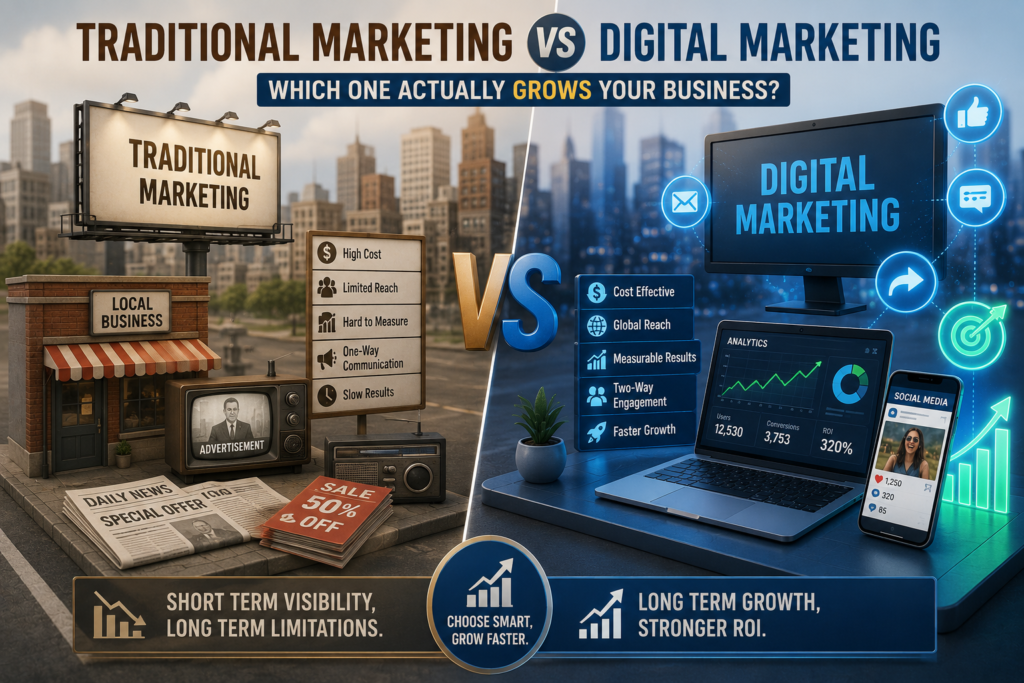
If you’ve ever sat in a budget meeting arguing over whether to buy a billboard or boost an Instagram post, you already know the tension at the heart of this article. The traditional marketing vs digital marketing debate isn’t going away, and honestly, it shouldn’t. Both approaches still have a place in 2026 the question is knowing which one earns its keep for your specific goals, audience, and budget.
This isn’t a “digital wins, traditional is dead” piece. That’s lazy thinking, and it ignores the fact that plenty of billion dollar brands still run TV spots and print campaigns. Instead, we’ll walk through how these two worlds actually differ, where each one shines, what it costs, and how to decide which combination makes sense for your business. By the end, you’ll have a clear, practical framework not just theory.
Table of Contents
What Is Traditional Marketing?
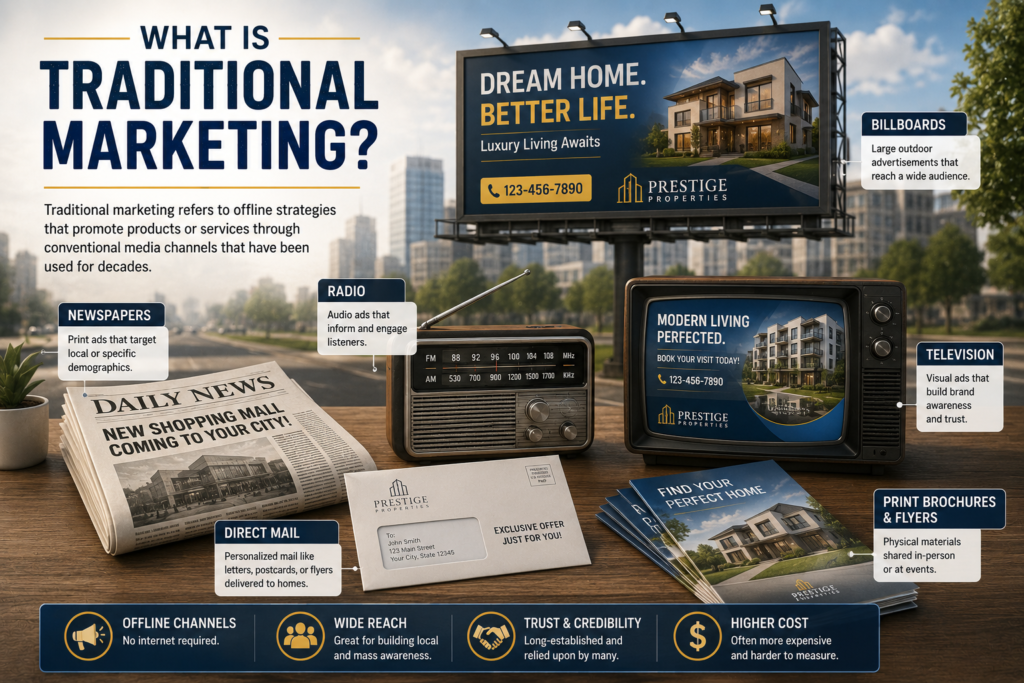
Traditional marketing refers to the offline promotional methods that businesses relied on long before the internet became a marketing channel: think print ads, TV commercials, radio spots, billboards, direct mail, and event sponsorships. It’s marketing that reaches people through physical or broadcast media rather than a screen connected to the internet.
Common Examples of Traditional Marketing
If you’re trying to picture what falls into this bucket, here are some of the most recognizable examples of traditional marketing:
- Television and radio commercials — still a go-to for national brand awareness
- Print advertising — newspapers, magazines, and trade publications
- Direct mail — postcards, catalogs, and flyers sent to a physical address
- Billboards and out-of-home (OOH) ads — highway signage, transit ads, bus wraps
- Cold calling and door-to-door sales — still used heavily in real estate and insurance
- Networking events, trade shows, and sponsorships — face-to-face relationship building
What ties all of these together is that they’re broadcast style: you’re pushing a message out to a broad audience and hoping the right people notice, rather than targeting individuals based on their online behavior.
What Is Digital Marketing?
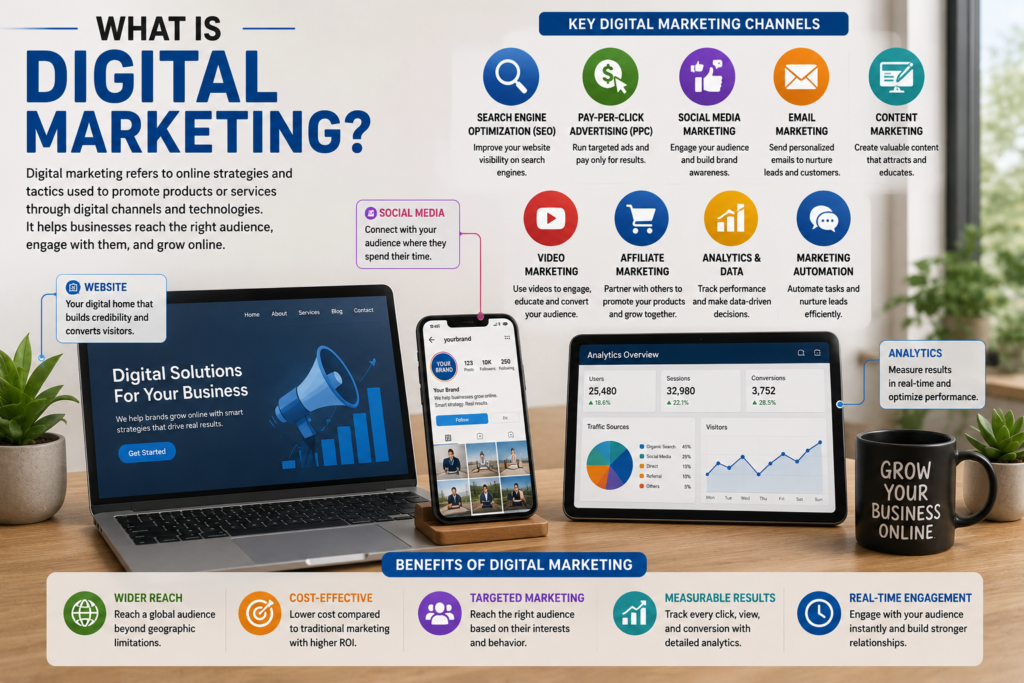
Digital marketing covers every promotional effort delivered through an internet-connected channel websites, search engines, social media, email, and apps. It includes tactics like SEO, pay-per-click advertising, social media marketing, email campaigns, content marketing, and influencer partnerships.
The defining trait of digital marketing is measurability. Every click, impression, and conversion can be tracked, which means campaigns can be adjusted mid-flight instead of waiting until the whole thing is over to find out if it worked.
For example, a local business might combine SEO with paid search to capture nearby customers actively searching for their services a strategy explored in more depth in resources on digital marketing for franchise businesses, where consistent local visibility across multiple locations becomes the priority.
Traditional Marketing vs Digital Marketing: Key Differences
Here’s where the comparison really matters. Let’s break down digital marketing vs traditional marketing across the factors that actually influence a business decision.
1. Cost and Budget Flexibility
Traditional advertising tends to require a bigger upfront commitment. A 30-second national TV spot, a full page magazine ad, or a season of billboard rental isn’t cheap, and once it’s live, you can’t easily pull it back or tweak the message.
Digital campaigns, by contrast, can start with a modest daily budget. A small business can run a $20 a day social ad and scale it up only once it proves it’s working. This flexibility is one of the biggest reasons digital has become the default starting point for smaller companies and startups.
2. Audience Targeting and Precision
This is arguably the sharpest line between the two. Traditional advertising is broad by nature a billboard reaches everyone driving past it, regardless of whether they’re a potential customer. Digital marketing lets you target by age, location, interests, browsing behavior, device, and even past purchase history.
That precision is a major reason digital ad spend has grown so aggressively. Industry forecasts put global digital advertising spend at roughly $740 billion in 2026, accounting for around 73% of total global media investment a clear signal of where marketing budgets are heading, even as traditional formats like out-of-home and cinema continue to see modest growth of their own.
3. Measuring Return on Investment
With traditional marketing, measuring exact ROI has always been tricky. You might see a bump in foot traffic after a radio ad runs, but attributing that increase directly to the ad versus seasonality, word of mouth, or a competitor closing is guesswork at best.
Digital marketing solves this with built-in analytics. You can see exactly how many people clicked an ad, how long they stayed on your site, and whether they completed a purchase. Tools that connect marketing performance to real business outcomes, like those covered in guides on app-based digital marketing strategy, make this kind of granular tracking accessible even to smaller teams.
4. Speed and Adaptability
Launching a traditional campaign often takes weeks or months of planning, production, and media buying. Once it airs or prints, changes are difficult or impossible.
Digital campaigns can go live in hours and be adjusted in real time. If an ad isn’t converting, you can pause it, swap the creative, or shift budget to a better-performing channel all without wasting the whole spend.
5. Audience Reach and Trust
Traditional media still holds an edge in one area: perceived credibility. Many consumers, particularly older demographics, still associate TV and print with established, trustworthy brands. A well placed print feature or a local news segment can carry a weight that a social ad sometimes can’t match.
Digital marketing, meanwhile, wins on sheer reach and frequency. A single piece of content can be shared, reshared, and discovered organically for years, something a print ad simply can’t do once the issue is recycled.
Digital vs Traditional Marketing: Which Delivers Better Engagement?
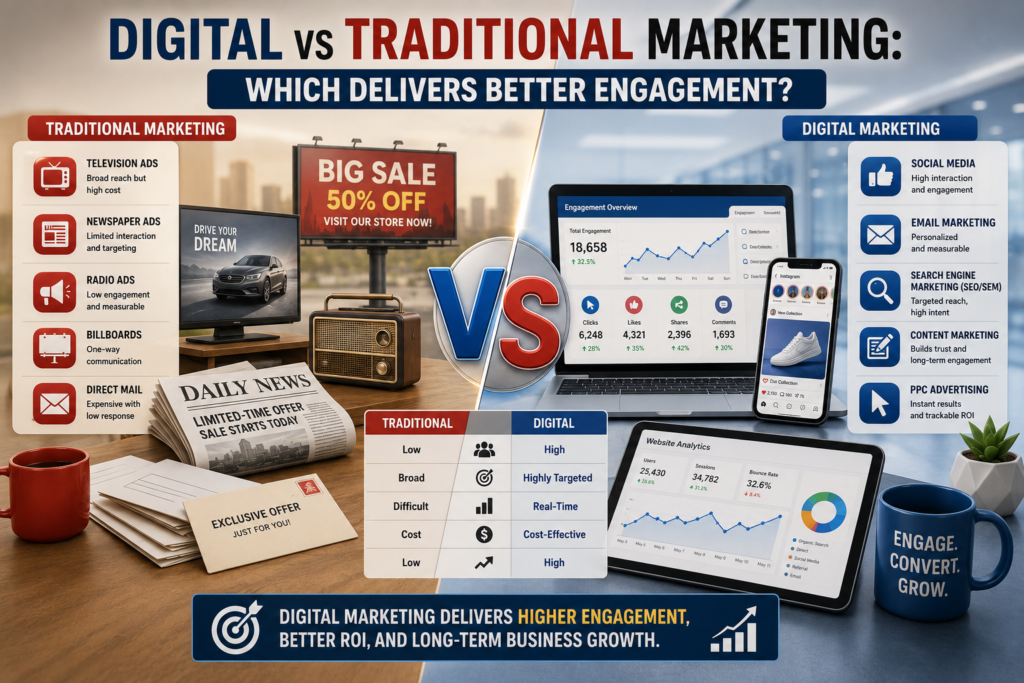
Engagement is where digital marketing has the clearest structural advantage. Traditional advertising is a one way conversation you broadcast a message and hope it lands. Digital marketing is interactive by design: people can comment, share, ask questions, or click straight through to make a purchase.
That said, traditional formats aren’t entirely passive anymore. Direct mail with QR codes, TV ads with hashtags, and radio spots that direct listeners to a website are all attempts to bridge the two worlds. This blending is actually where a lot of smart marketing strategy lives today using traditional reach to drive digital action.
Digital Versus Traditional Marketing: Which Is Right for Your Business?
There’s no universal winner here, and any consultant who tells you otherwise is oversimplifying. The right approach depends on a few honest questions:
- Who is your audience? Younger, urban, tech comfortable audiences typically respond better to digital channels. Older or hyper-local audiences may still respond strongly to direct mail, local radio, or community sponsorships.
- What’s your budget? Smaller budgets generally stretch further with digital, where you can test cheaply before scaling.
- What’s your sales cycle? High consideration purchases (like real estate or B2B services) often benefit from a mix traditional media builds trust and awareness, while digital nurtures and converts.
- How fast do you need results? Digital wins for speed. Traditional wins for slow-building brand equity.
For most businesses in 2026, the smartest answer isn’t “traditional vs digital” it’s a blended strategy where each channel plays to its strength. A restaurant might run local radio spots for brand familiarity while using geo-targeted social ads to drive same-week reservations. A franchise business might combine regional print sponsorships with the kind of localized digital campaigns discussed in resources on franchise digital marketing to stay visible across every location.
Frequently Asked Questions
Is digital marketing cheaper than traditional marketing? Generally, yes. Digital campaigns can launch with smaller budgets and scale gradually, while traditional media like TV and print usually require a larger upfront investment before the campaign even runs.
Is traditional marketing still effective in 2026? Yes, particularly for building brand trust, reaching local or older audiences, and supporting high value purchases. Traditional out of home and TV spending is still forecast to grow modestly even as digital continues to dominate overall ad budgets.
What’s the biggest difference between traditional advertising and digital marketing? Measurability and targeting. Digital marketing lets you track performance in real time and target specific audience segments, while traditional advertising reaches a broad audience with limited ability to measure direct impact.
Should a small business focus on digital or traditional marketing? Most small businesses get more value starting with digital marketing because of lower costs and better targeting, but local traditional tactics like community sponsorships or direct mail can still work well alongside it.
Can traditional and digital marketing work together? Absolutely. Many of the most effective campaigns use traditional media to build broad awareness and digital channels to capture and convert that attention for example, a billboard with a QR code linking to a landing page.
Final Thoughts: Building a Strategy That Uses Both
The real takeaway from the traditional marketing vs digital marketing conversation is that this was never meant to be an either/or decision. Traditional marketing still has staying power for brand trust and mass reach, while digital marketing offers precision, speed, and measurable results that traditional channels simply can’t replicate on their own.
If you’re mapping out your next campaign, start by getting clear on your audience and goals, then build a channel mix that plays to the strengths of both. And if you want a deeper look at how digital tactics can support your broader marketing plan, explore how businesses are using app based digital strategies to turn everyday engagement into real conversions. Ready to build a marketing plan that actually fits your business? Start by auditing your current channel mix this week and identify one traditional and one digital tactic you can test together.