
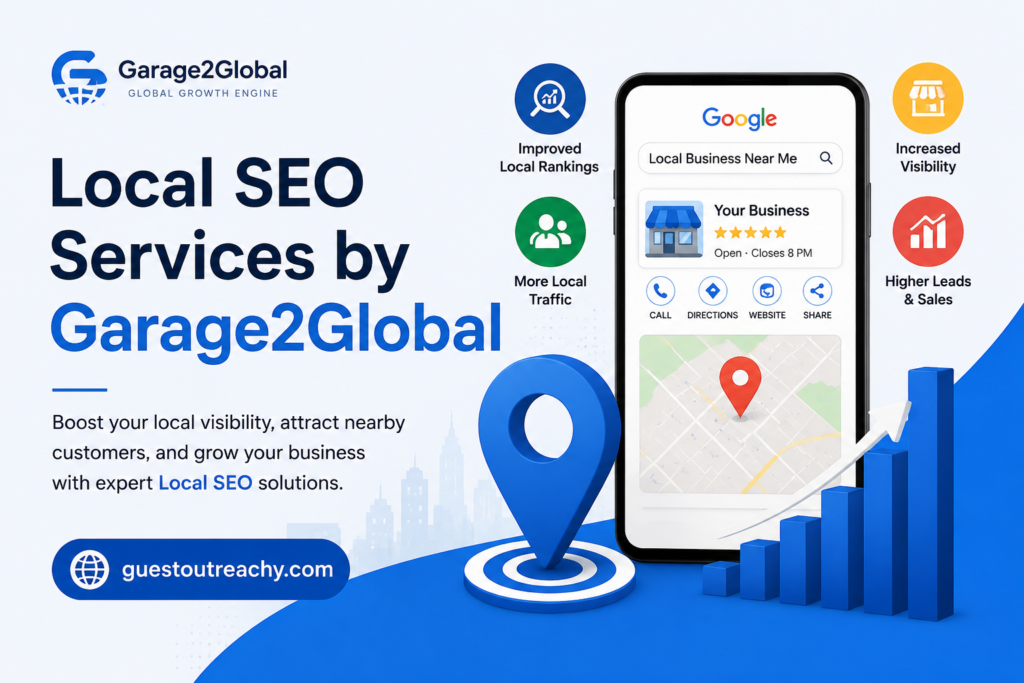
Local customers now rely on Google to find nearby products and services, making local SEO an essential part of business growth. A strong local SEO strategy helps improve search rankings, increase website traffic, and attract customers who are ready to take action.
This guide explains how local SEO works, its key benefits, and the best practices for improving your online visibility. Whether you’re learning the basics or exploring Local SEO Services by Garage2Global you’ll discover practical strategies to strengthen your local presence and generate more qualified leads.
What Is Local SEO?
Local SEO, or Local Search Engine Optimization, is the process of improving a business’s online visibility for searches performed within a specific geographic area. Unlike traditional SEO, which often targets national or global audiences, local SEO is designed to help businesses appear when people search for nearby services.
Think about how people search today. They don’t simply type “electrician” or “coffee shop.” Instead, they search for phrases like:
- Emergency plumber near me
- Best dentist in Dallas
- Coffee shop open now
- Roofing contractor in Chicago
- Family lawyer near me
Google understands that these searches have local intent. Instead of displaying random businesses from across the country, it prioritizes companies located close to the searcher.
That’s where local SEO becomes essential.
Why Local SEO Matters More Than Ever
Consumer behavior has changed dramatically over the last decade.
People expect instant answers. They want directions, phone numbers, reviews, pricing information, and business hours within seconds. If your business doesn’t appear when they’re searching, they’re likely to choose a competitor instead.
Local SEO helps bridge that gap by making your business visible at the exact moment potential customers are looking for your services.
Some of the biggest advantages include:
Increased Visibility
Higher rankings mean more people discover your business without paying for every click.
Better Quality Leads
Visitors arriving through local searches are often ready to call, book, or visit, making them far more valuable than untargeted traffic.
Higher Trust
Businesses with complete profiles, positive reviews, and accurate information naturally appear more trustworthy.
Long-Term Growth
Unlike paid advertising that stops delivering results when your budget ends, SEO continues generating traffic over time with consistent optimization.
How Local Search Works
Google evaluates hundreds of ranking signals before deciding which businesses appear in local search results.
Although the algorithm changes regularly, three major factors remain especially important.
Relevance
Google determines how closely your business matches a user’s search. This depends on your website content, business categories, service descriptions, and keywords.
Distance
Location plays a significant role. Google attempts to display businesses that are geographically convenient for the searcher.
Prominence
Prominence reflects your business’s overall reputation online. Reviews, backlinks, citations, mentions across the web, and brand recognition all contribute to this factor.
The stronger these signals are, the better your chances of appearing in both Google Maps and organic search results.
The Foundation of a Successful Local SEO Strategy
Many businesses make the mistake of focusing on only one aspect of SEO. They might optimize their website but ignore reviews, or they collect reviews without improving their site.
Successful local SEO works because every component supports the others.
A strong strategy usually includes:
- Website optimization
- Google Business Profile optimization
- Local keyword research
- High-quality content
- Citation management
- Technical SEO
- Online reputation management
- Local link building
- Performance monitoring
When these elements work together, they create a solid foundation for sustainable growth.
Build a Website That Supports Local SEO
Your website acts as your digital storefront.
Even if customers first discover you through Google Maps, many will visit your website before contacting you.
A well-designed website should answer common questions quickly while encouraging visitors to take action.
Important elements include:
Fast Loading Speed
Slow websites create a poor user experience and often lose visitors before they even view your services.
Compressing images, minimizing unnecessary scripts, and using reliable hosting all contribute to faster performance.
Mobile-Friendly Design
Most local searches happen on smartphones.
Your website should display correctly on every screen size, making it easy to call, request a quote, or navigate your pages.
Clear Navigation
Visitors shouldn’t struggle to find important information.
Keep menus simple and organize services logically so users can move through your website effortlessly.
Strong Calls to Action
Every important page should encourage visitors to take the next step.
Examples include:
- Call today
- Request a free estimate
- Schedule an appointment
- Book online
- Contact our team
Simple, direct calls to action improve conversion rates.
Understanding Local Keywords
Keyword research forms the backbone of every successful SEO campaign.
Instead of targeting broad terms with intense competition, local businesses benefit from location-specific searches that indicate buying intent.
Examples include:
- HVAC repair in Miami
- Roof replacement Houston
- Family dentist Boston
- Wedding photographer Seattle
- Personal trainer Austin
These searches usually attract visitors who are much closer to making a purchase.
Long-tail keywords also help businesses compete against larger companies because they target more specific customer needs.
Creating Service Pages That Rank
One of the most effective ways to improve local visibility is by creating dedicated pages for each service you provide.
Instead of placing every service on one page, separate them into focused pages.
For example, a plumbing company might have individual pages for:
- Drain cleaning
- Water heater installation
- Leak detection
- Sewer repair
- Emergency plumbing
- Pipe replacement
Each page should explain the service in detail, answer customer questions, include original content, and encourage visitors to contact the business.
This structure helps search engines understand your expertise while improving user experience.
Why Content Marketing Supports Local SEO
Many business owners think blogging is only for large companies.
In reality, educational content helps local businesses attract potential customers long before they’re ready to buy.
Helpful articles answer common questions while building trust.
Examples include:
- How often should you service your air conditioner?
- Signs your roof needs replacement
- Tips for preventing clogged drains
- What to expect during a home inspection
- How to prepare for a pest control visit
Content like this positions your business as a reliable source of information while creating additional opportunities to rank for valuable search terms.
More importantly, useful content keeps visitors engaged, encourages sharing, and increases the likelihood that they’ll return when they need professional help.
Common Local SEO Mistakes
Many businesses unknowingly limit their growth by making avoidable mistakes.
Some of the most common include:
- Publishing thin or duplicate content
- Ignoring mobile optimization
- Using outdated contact information
- Failing to update business hours
- Neglecting customer reviews
- Targeting overly broad keywords
- Creating poor-quality location pages
- Inconsistent business information across directories
Correcting these issues often produces noticeable improvements in local search performance without requiring major website redesigns.
Google Business Profile The Cornerstone of Local SEO
When people search for a nearby business, one of the first things they see is the Google Business Profile (formerly Google My Business). This profile often appears before a website in search results, making it one of the most influential assets for attracting local customers.
A fully optimized profile allows potential customers to:
- View your business hours
- Get directions
- Call with a single tap
- Visit your website
- Read customer reviews
- Browse photos
- Ask questions
- Learn about your services
Google prefers businesses that keep their profiles complete and up to date. An incomplete profile may reduce customer confidence and affect your visibility in local search results.
Complete Every Section
Many businesses fill in only the basics and leave the rest blank. Instead, complete every available field, including:
- Business name
- Primary and secondary categories
- Phone number
- Website URL
- Physical address or service area
- Opening hours
- Business description
- Services
- Products (where applicable)
- Appointment links
The more information Google has, the easier it becomes to understand what your business offers.
The Power of Customer Reviews
Online reviews influence both search rankings and customer decisions.
Imagine two businesses offering the same service. One has hundreds of recent positive reviews, while the other has only a handful. Most customers will naturally trust the business with stronger social proof.
Encourage satisfied customers to leave honest feedback after completing a project or delivering a service. A simple follow-up email or text message can significantly increase the number of reviews you receive.
Equally important is responding to reviews.
Thank customers for positive feedback and address negative reviews professionally. This demonstrates that your business values customer satisfaction and actively engages with its audience.
Local Citations Build Trust
A local citation is any online mention of your business’s name, address, and phone number (commonly known as NAP).
These citations appear on:
- Business directories
- Local chambers of commerce
- Industry-specific directories
- Community websites
- Mapping platforms
Search engines compare this information across the web. If your business details remain consistent everywhere, Google gains greater confidence in the legitimacy of your business.
However, inconsistent listings—such as different phone numbers or outdated addresses—can create confusion for both customers and search engines.
Perform regular citation audits to ensure every listing contains accurate information.
Local Link Building
Backlinks remain one of Google’s strongest ranking factors.
For local businesses, quality matters far more than quantity.
Useful opportunities include:
- Local news websites
- Community organizations
- Business associations
- Industry blogs
- Charity sponsorships
- Local events
- Educational institutions
- Professional partnerships
For example, sponsoring a neighborhood event may earn a valuable backlink from the event website while also increasing brand awareness within your community.
Technical SEO Still Matters
Many business owners focus only on keywords while overlooking technical optimization.
A technically healthy website provides a better experience for users and allows search engines to crawl your pages efficiently.
Important technical factors include:
Secure Website (HTTPS)
Visitors expect secure websites. HTTPS protects user data and is a recognized ranking signal.
Fast Performance
Every extra second of loading time increases the likelihood that visitors will leave your website before taking action.
Optimize images, reduce unnecessary code, and enable browser caching to improve speed.
Mobile Optimization
Since the majority of local searches happen on mobile devices, responsive design is essential.
Buttons should be easy to tap, text should remain readable, and forms should work smoothly on smaller screens.
Structured Data
Schema markup helps search engines understand important business information, including:
- Business name
- Address
- Phone number
- Reviews
- Opening hours
- Services
Although visitors rarely notice structured data, search engines use it to better interpret your content.
Creating Location Pages
Businesses serving multiple cities should avoid placing every location on a single page.
Instead, create dedicated pages for each area you serve.
For example:
- Roofing Services in Dallas
- Roofing Services in Fort Worth
- Roofing Services in Plano
- Roofing Services in Arlington
Each page should contain unique content describing local services, customer needs, nearby landmarks where appropriate, and relevant contact information.
Avoid copying the same text and simply changing the city name. Duplicate content provides little value and may limit ranking potential.
Why Consistent Content Publishing Matters
SEO is not a one-time project.
Search engines reward websites that continue publishing fresh, useful content.
An effective publishing schedule might include articles such as:
- Seasonal maintenance tips
- Frequently asked questions
- Industry trends
- Customer success stories
- Service comparisons
- Buying guides
- Cost breakdowns
Over time, this growing library of content increases keyword coverage and demonstrates topical authority.
Measuring Success
Without tracking performance, it’s impossible to know whether your SEO efforts are producing results.
Key performance indicators include:
- Organic traffic
- Google Business Profile views
- Phone calls
- Website form submissions
- Direction requests
- Keyword rankings
- Conversion rate
- Bounce rate
- Average engagement time
Monitoring these metrics helps identify strengths while revealing opportunities for improvement
Example How Local SEO Can Transform a Business
Imagine a family-owned plumbing company serving one metropolitan area.
The company has an attractive website but receives very little traffic. Their Google Business Profile hasn’t been updated in over a year, and customer reviews are limited.
They decide to improve their local SEO by taking the following steps:
- Updating every business detail
- Adding professional project photos
- Requesting reviews from satisfied customers
- Creating separate service pages
- Publishing educational blog articles
- Correcting inconsistent directory listings
- Improving website speed
- Building relationships with local organizations for backlinks
Over the following months, they begin appearing more frequently in local searches. Website traffic increases, phone inquiries grow, and more customers discover the business through Google Maps rather than paid advertisements.
This example demonstrates that sustainable growth often comes from consistent optimization rather than quick shortcuts.
Comparing Traditional Marketing with Local SEO
| Feature | Traditional Marketing | Local SEO |
|---|---|---|
| Audience Reach | Broad audience | People actively searching nearby |
| Cost | Often recurring and expensive | Long-term investment |
| Targeting | Limited geographic precision | Highly location-specific |
| Performance Tracking | Difficult | Detailed analytics available |
| Customer Intent | General awareness | High purchase intent |
| Long-Term Value | Ends when campaigns stop | Continues generating organic visibility |
| Trust Factor | Depends on brand recognition | Supported by reviews and local presence |
| Scalability | Requires additional budget | Grows with ongoing optimization |
This comparison highlights why many local businesses are shifting more of their marketing budget toward search engine optimization.
Choosing the Right SEO Strategy
No two businesses are exactly alike.
A neighborhood café, legal practice, home service company, and dental clinic all serve different audiences. Their marketing strategies should reflect those differences.
The best SEO plans begin by understanding:
- Business goals
- Target customers
- Geographic service area
- Competitive landscape
- Available budget
- Existing online presence
Whether you’re building your own strategy or evaluating Local SEO Services by Garage2Global, focus on sustainable techniques that prioritize quality content, technical excellence, and customer experience instead of shortcuts that promise instant rankings.
Advanced Local SEO Strategies That Deliver Long-Term Results
Once you’ve built a strong foundation with an optimized website, Google Business Profile, quality content, and consistent business information, it’s time to focus on strategies that can help you stay ahead of the competition. These techniques require ongoing effort, but they often produce sustainable growth over the long term.
Focus on User Experience
Search engines want to recommend websites that provide an excellent experience. If visitors quickly leave your website because it’s confusing or slow, your rankings may suffer over time.
Improve the user experience by:
- Making navigation simple and intuitive.
- Keeping important information easy to find.
- Using clear headings and readable fonts.
- Compressing images for faster loading.
- Ensuring contact forms are short and easy to complete.
- Displaying phone numbers prominently on every page.
A positive user experience not only helps SEO but also increases the chances of turning visitors into paying customers.
Build Local Authority
Search engines evaluate your reputation within your local community. Businesses that actively participate in their communities often earn valuable mentions and backlinks that strengthen their online authority.
Some effective ways to build local authority include:
- Sponsoring local events.
- Supporting community charities.
- Joining local business associations.
- Partnering with nearby businesses.
- Publishing local success stories.
- Sharing community news related to your industry.
These activities create natural opportunities for people to talk about your business online while strengthening your brand.
Optimize for Voice Search
Voice searches continue to grow as more people use smartphones and smart speakers.
Instead of typing short keywords, users often ask complete questions like:
- Who is the best electrician near me?
- Where can I find an emergency plumber?
- Which dentist is open today?
- How much does roof repair cost nearby?
Creating FAQ sections and writing conversational content helps your website match these natural search patterns.
Don’t Ignore Image Optimization
Images contribute more to SEO than many business owners realize.
Every image should include:
- A descriptive file name.
- Optimized file size.
- Relevant alt text.
- High-quality resolution.
- Original photography whenever possible.
Original images of your team, office, completed projects, or products build trust and differentiate your website from competitors using generic stock photos.
Keep Your Content Updated
Publishing content is only half the job. Existing pages should also be reviewed regularly.
Update older articles by:
- Adding recent statistics.
- Improving readability.
- Expanding useful sections.
- Replacing outdated information.
- Including new internal links.
- Refreshing images.
Fresh content signals that your website remains active and relevant.
Common Local SEO Mistakes to Avoid
Even businesses with good intentions sometimes limit their results by making preventable mistakes.
Keyword Stuffing
Repeating the same keyword unnaturally throughout a page creates a poor reading experience and may negatively affect rankings.
Ignoring Mobile Users
Most local searches happen on mobile devices. A desktop-only experience will likely lose potential customers.
Buying Low-Quality Backlinks
Quality always outweighs quantity. Unnatural backlinks can damage your website’s credibility.
Publishing Duplicate Content
Every service page and location page should provide unique value rather than repeating the same information.
Forgetting Analytics
Without monitoring performance, you won’t know which strategies are working or where improvements are needed.
A Simple Local SEO Action Plan
If you’re just getting started, follow this practical roadmap.
Month 1
- Audit your website.
- Update your Google Business Profile.
- Fix inaccurate business listings.
- Improve website speed.
Month 2
- Create dedicated service pages.
- Research local keywords.
- Publish your first educational blog posts.
- Request reviews from existing customers.
Month 3
- Build relationships for local backlinks.
- Continue publishing helpful content.
- Monitor rankings.
- Analyze visitor behavior.
Ongoing
- Update content regularly.
- Respond to every customer review.
- Add new project photos.
- Track conversions.
- Refine your strategy based on performance.
SEO is not about quick wins. Consistency produces the strongest long-term results.
The Future of Local SEO
Local search continues to evolve as search engines become better at understanding user intent.
Several trends are expected to shape the future:
- Increased use of artificial intelligence in search results.
- Greater importance of user experience.
- More personalized local recommendations.
- Continued growth of voice search.
- Better integration of maps and mobile devices.
- Stronger emphasis on authentic reviews and customer engagement.
Businesses that adapt to these changes early will be better positioned to maintain their visibility.
Frequently Asked Questions
What is local SEO?
Local SEO is the process of optimizing a business’s online presence so it appears more prominently in location-based search results on search engines like Google.
Who should invest in local SEO?
Any business that serves customers within a specific geographic area can benefit from local SEO, including restaurants, plumbers, dentists, lawyers, real estate agencies, salons, gyms, and retail stores.
How long does local SEO take?
While some improvements can appear within a few weeks, meaningful growth usually takes three to six months, depending on your competition, website quality, and consistency.
Is local SEO better than paid advertising?
They serve different purposes. Paid advertising provides immediate visibility, while local SEO builds sustainable organic traffic over time. Many successful businesses use both strategies together.
Do online reviews improve rankings?
Reviews help build trust with potential customers and contribute to local search visibility. Consistently receiving genuine reviews is an important part of any local SEO strategy.
How often should I update my website?
Review your website at least once every few months. Add new content, refresh older articles, update service information, and ensure all business details remain accurate.
Final Thoughts
Local SEO is no longer optional for businesses that rely on nearby customers. As more people use search engines to find products and services in their area, appearing in local search results becomes one of the most effective ways to generate qualified leads and build long-term growth.
Success doesn’t come from shortcuts or one-time optimizations. It comes from maintaining an accurate online presence, publishing valuable content, earning customer trust, and continuously improving your website based on real performance data.
Whether you choose to manage your SEO in-house or explore Local SEO Services by Garage2Global, the most important factor is consistency. Businesses that invest in quality optimization today are far more likely to earn greater visibility, stronger customer relationships, and lasting success in the years ahead.