

Written by the Guest Outreachy team. Last updated July 2026
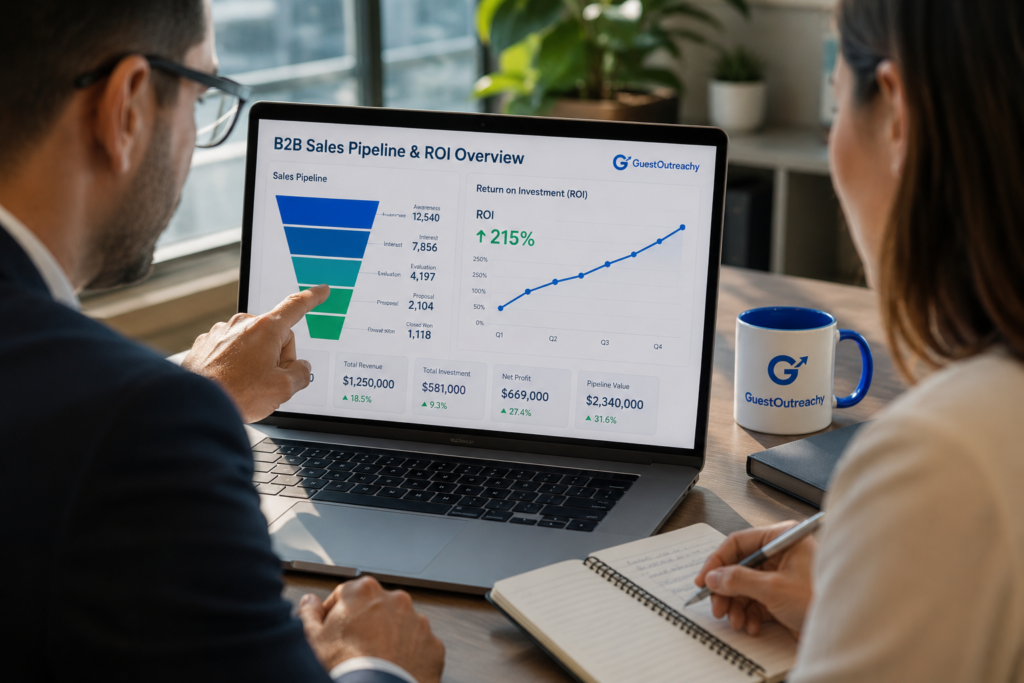
Most B2B companies still buy SEO the way they would buy consumer marketing. They ask for more traffic and more keywords and hope pipeline follows. That approach was already weak a few years ago and it is noticeably weaker now that search itself has changed shape. Good b2b seo services in 2026 are built around a very different reality than the one most buyers still assume they are paying for.
The buying process behind most B2B purchases involves several decision makers and a long sales cycle. Search terms used in this space are specific and technical and often low volume in a way that would make a typical consumer marketer walk away. That difference is exactly why generic SEO advice performs so poorly when applied to B2B without adjustment. A tactic that works well for an ecommerce store selling to individual shoppers can fall flat entirely for a company selling software to a procurement committee.
Table of Contents
Why B2B SEO Services Need a Different Playbook in 2026
Search itself has fragmented. A large share of Google searches now end without any click at all because the answer appears directly on the results page. Independent clickstream research has put this figure above half of all searches in the United States. On top of that G2 research from early 2026 found that a majority of B2B buyers now start their research with an AI chatbot more often than with a traditional search engine.
None of this means organic visibility stopped mattering. It means the old model of click to website to form fill is no longer the whole picture. A buyer might read an AI generated summary that cites your page without ever visiting it and still walk into a sales call already trusting your brand because your content shaped that summary. Good b2b seo services in 2026 are built to win in both places at once rather than optimizing purely for clicks.
What a Modern B2B SEO Program Actually Covers
| Area | What It Involves | Why It Matters for B2B |
|---|---|---|
| Technical foundation | Crawlability and site speed and structured data and clean indexing | Feeds both traditional search and AI systems that summarize your content |
| Topical authority | A connected hub of content covering the niche from multiple angles | Buyers and AI systems both reward depth over scattered one off posts |
| Bottom funnel content | Comparison pages and use case pages and pricing and integration pages | These are the pages that actually influence a buying decision not just traffic |
| Thought leadership | Original data and executive perspective and real customer stories | Senior buyers are already flooded with generic opinion content and remember what stands out |
| Measurement | Organic visibility tied to pipeline and SQLs and LTV to CAC | Traffic in a vacuum no longer justifies budget to most finance teams |
Depth Beats Volume Now More Than Ever
Search engines have gotten noticeably stricter about what counts as genuinely useful content since the major quality focused updates of the last two years. Thin or scattered content that would have quietly ranked in 2022 now struggles to hold position at all. This pattern hits B2B sites especially hard because so many of them built their content around a long list of shallow blog posts rather than a small number of deep and connected resources.
The programs performing well in 2026 tend to concentrate effort into fewer and deeper assets. A single well researched piece backed by original survey data or real usage numbers and supported by a slide deck and a short executive video tends to outperform a dozen generic posts covering the same ground at a shallow level. This also happens to be exactly the kind of content that AI systems are more likely to cite and summarize favorably since it contains specific claims rather than recycled generalities.
Return on Investment Data Worth Knowing
Buyers evaluating whether to invest in b2b seo services often want a real number rather than a vague promise. First Page Sage 2026 analysis of B2B SaaS companies found a three year return on investment of roughly 700 percent for organic search programs. Thought leadership focused programs performed meaningfully better than purely technical programs measured in isolation.
| Program Focus | Approximate 3 Year ROI | Notes |
|---|---|---|
| Thought leadership led SEO | Highest of the three | Original data and executive perspective drive the strongest returns |
| Balanced organic search program | Roughly 700 percent | Combines technical health and content depth and authority building |
| Purely technical SEO alone | Lowest of the three | Technical fixes matter but rarely move pipeline without content depth |
The pattern across nearly every credible study on this topic is the same. Technical work is necessary but not sufficient. Content depth and genuine expertise are what convert visibility into pipeline. This is precisely why b2b seo services built only around technical audits tend to underdeliver on their own.
Bottom of Funnel Pages Get Overlooked Constantly
A huge share of B2B SEO effort still goes into top of funnel blog content while the pages that actually influence a purchase decision sit thin and neglected. Comparison pages against named competitors and detailed use case pages for specific industries and clear pricing or integration pages are where a buyer makes their final decision. These pages are frequently an afterthought compared to the blog.
According to Google Search Central content should be created primarily to help the people reading it rather than mainly to attract search traffic. For B2B this principle points directly at these bottom funnel pages. A comparison page that honestly walks through tradeoffs rather than dismissing every competitor outright earns more trust from a technical buyer and tends to perform better in search over time as a result.
Where Guest Outreachy Fits Into This
Our own SEO audit services are built around this exact shift. A B2B audit in 2026 has to look past keyword rankings and check whether the technical foundation supports AI citation and whether the content hub has real depth around the core niche and whether the bottom funnel pages are actually built to close a sale rather than just exist. Fixing keyword gaps without fixing that structure tends to produce visibility that never turns into pipeline.
A Realistic B2B SEO Timeline
| Phase | Typical Timeframe | What to Expect |
|---|---|---|
| Technical and content audit | Weeks 1 to 3 | A clear picture of gaps across technical health and content depth and funnel coverage |
| Foundational fixes and hub planning | Weeks 4 to 10 | Technical issues resolved and topical hub structure mapped out |
| Content and authority building | Months 3 to 6 | Deep content assets published and bottom funnel pages strengthened |
| Compounding visibility | Months 6 to 12 and beyond | Organic search increasingly contributes to qualified pipeline rather than raw traffic |
B2B sales cycles are long and search algorithms need real time to evaluate new signals so this timeline reflects reality rather than a sales pitch. Anyone promising fast pipeline results from B2B SEO alone is either underestimating the sales cycle or overselling the channel.
A Few Questions B2B Marketing Leaders Actually Ask
Does SEO still matter if most of our buyers use AI chatbots to research us? It matters more not less. AI systems draw their answers from indexed and well structured and genuinely authoritative content. A weak or thin web presence gets summarized poorly or skipped entirely while a deep and well organized one shapes how the AI describes your company before a buyer ever visits your site.
How is B2B SEO different from B2C SEO in practice? B2C SEO usually optimizes for volume and quick purchase decisions. B2B SEO has to account for multiple decision makers and longer research cycles and lower search volume terms that still carry high buying intent. The content and measurement approach both need to reflect that difference. This is one of the clearest reasons generic seo services rarely translate well into effective b2b seo services without real adjustment.
What should we measure instead of just traffic? Organic contribution to sales qualified leads and influenced pipeline and the ratio of customer lifetime value to acquisition cost. Traffic alone rarely satisfies a finance team evaluating channel investment anymore.
Final Thoughts
B2B SEO in 2026 is no longer a game of chasing rankings for their own sake. Search results themselves now answer many questions before a buyer clicks anything and AI systems shape buyer perception before a website visit ever happens. Good b2b seo services are built around that reality from the start combining a solid technical foundation with genuine depth and honest bottom funnel content rather than chasing traffic that never turns into revenue.
The companies still treating SEO as a traffic channel from 2020 will keep wondering why their numbers look fine while pipeline stays flat. The ones adjusting to how buyers actually research now across both traditional search and AI systems are the ones building visibility that compounds into something a finance team can actually justify year over year.