
By Guest Outreachy Team
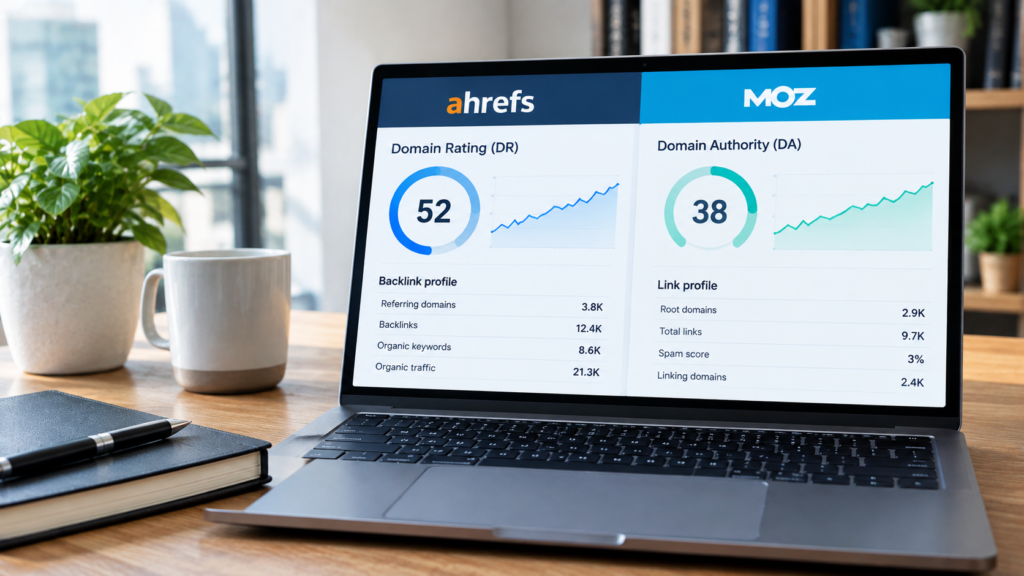
A website can show a Domain Rating of 52 in Ahrefs and a Domain Authority of 38 in Moz, and both numbers can be working exactly as designed. They come from different link databases, different formulas and different goals, which is why people who compare Ahrefs DR vs Moz DA head to head end up arguing about the wrong thing.
This guide sets the two scores side by side, explains how each one is built, shows how link sellers use them and ends with a plain rule for choosing one. If you buy or sell placements, our breakdown of guest post cost shows how DR bands move prices, and our look at the guest post marketplace explains why listed scores deserve a second look.
Short answer: Ahrefs DR measures link popularity, meaning how many unique domains link to a site with followed links and how much strength they pass. Moz DA is a machine learned prediction of how likely a site is to rank. Both are third party estimates, neither is a Google ranking factor and numbers from the two tools should never be compared directly.
Table of Contents
Ahrefs DR vs Moz DA at a Glance
| Feature | Ahrefs DR | Moz DA |
|---|---|---|
| Owner | Ahrefs | Moz |
| Scale | 0 to 100, logarithmic | 1 to 100 |
| Core idea | Link popularity of a whole website | Predicted ability to rank, used as a comparison |
| Method | A formula that passes value from linking domains, similar in spirit to PageRank | A machine learning model, a neural network since version 2.0 in 2019 |
| Main inputs | Domains with followed links, the DR of those domains and how many sites they link to | Linking root domains, total links, Spam Scores and other proprietary signals |
| Nofollow links | Do not raise DR | Rule not published |
| Spam handling | Does not filter spam, so low quality links can raise it | Spam Score is a model input, and Moz says the model devalues manipulation patterns |
| Other signals | None. Ignores traffic, domain age and brand popularity | Not published beyond link and spam data |
| Page level partner | Ahrefs Rank orders sites by backlink strength | Page Authority scores single pages |
| Used by Google | No | No |
The row to notice first is the core idea. DR counts and weighs links in a fixed formula, while DA asks a model to guess ranking ability from link data. Everything else in the table follows from that difference.
Link Popularity Formula Explained
Ahrefs describes DR as the relative strength of the backlink profile of a website, shown on a logarithmic scale from 0 to 100. Logarithmic means the gap between DR 70 and DR 71 is much larger than the gap between DR 20 and DR 21, so each extra point costs more as the score rises. The Ahrefs glossary entry on website authority lists the three factors: the number of domains linking to the site, the DR of those domains and how many sites each of them links to, since a domain that links to many sites passes less to each.
In its Domain Rating explainer, Ahrefs adds the practical rules. A site that links to you only with nofollow links does not raise your DR, only the first link from a domain counts, and DR is purely link based, so it ignores search traffic, domain age and brand popularity. It also does not account for backlink spam, which means large amounts of low quality links can raise it. Ahrefs says some black hat SEOs found ways to inflate DR with link spam and that it closed many of those methods.
Ahrefs also tested the link between DR and results. It examined 218,713 domains that each ranked for at least 100 keywords and found a clear correlation between DR and organic keywords. That is a vendor study and a correlation, and Ahrefs itself reminds readers that Google ranks pages, not websites.
Machine Learned Prediction Model
Moz describes Domain Authority as a score from 1 to 100 that predicts how likely a website is to rank on search engine results pages. According to a Search Engine Land interview with Moz on Domain Authority 2.0, Moz principal search scientist Russ Jones said DA is calculated from linking root domains, the number of total links, spam scores and other proprietary metrics.
The version 2.0 update arrived on March 5, 2019. Moz replaced a linear regression model with a neural network, added random non ranking pages to the training data so the model could learn about sites that never rank, and used Link Explorer, which was monitoring more than 35 trillion links at the time. Moz also integrated its Spam Score, and scores fell by about 7 percent on average as the metric was re centered.
Moz stresses that DA is comparative. In the same interview Jones said that on its own, DA means very little, and that it becomes useful when you compare sites against competitors. He also listed Page Authority, keyword difficulty, keyword volume, rankings and click through rate as other numbers to watch. Moz treats the model weights as proprietary, and that 2019 interview remains the most detailed public account of how the score works.
Why One Site Gets Two Numbers
Three differences explain most gaps between the scores. The first is the data. Each tool crawls the web with its own index, Ahrefs with its own web index and Moz with Link Explorer, so each sees a different set of links to the same site. The second is the formula. DR follows a followed link formula, while DA runs a model that also uses Spam Score. The third is the scale, since DR starts at 0 and DA starts at 1.
Scores also move without any change on your side. Ahrefs notes that DR can drop even when you lose no backlinks, because when sites near the top of the scale gain links, everyone else is pushed down. The sensible conclusion is the one Moz gives for DA: compare sites inside one tool, never across tools.
Where Marketplaces Use Them
Link sellers sort inventory by these scores because buyers ask for them. In the Adsy inventory of 52,671 sites, analyzed in February 2026, the average guest post price climbed steeply with DR, and every ten extra points of DR added roughly 32 percent.
| DR band | Average guest post price |
|---|---|
| 1 to 30 | $332 |
| 31 to 70 | $555 |
| 71 and above | $2,025 |
That pricing logic is why inflated scores are tempting for sellers. When a listing shows a number, ask which tool produced it, then check the same site in that tool yourself. BuzzStream combines DR or DA with traffic thresholds when it grades marketplace sites, and a score on its own tells you about links, not about readers.
Matching Metric to Task
| Task | What to do | Why |
|---|---|---|
| Judging a guest post site | Use the metric from your own tool, then add traffic and topic fit | Both scores describe links, and neither shows readers |
| Comparing two competitors | Use the same tool for both | Scores from different tools are not comparable |
| Tracking your own progress | Pick one metric and watch the trend over months | Scores shift when a tool index changes or other sites gain links |
| Reporting to a client | Show the trend next to organic traffic | A score alone does not show business results |
| Deciding whether to buy a link | Check the page that carries the link, not only the domain | Google ranks pages, not websites |
The same rule sits under every row. Choose one score, stay consistent and treat it as a screening filter, because it was never built to replace a look at the actual page.
Mistakes That Waste Budget
The first mistake is chasing the score itself. Ahrefs advises against focusing efforts on growing DR, because both DR and traffic grow as a by product of producing strong content and earning links to it. The second is mixing scores, such as asking a seller for DA 40 and accepting a screenshot of DR 40.
The third is inflating the number. Ahrefs warns that manipulating authority metrics through private blog networks or link farms can lead to penalties because Google can recognize the pattern. The fourth is trusting a seller screenshot without checking traffic, topic fit and whether the link will carry a sponsored or nofollow tag.
Questions Readers Ask
Is Ahrefs DR the same as Moz DA? No. DR is a link popularity formula from Ahrefs, while DA is a machine learned ranking prediction from Moz, and each uses its own link index.
Which score is more accurate? We did not find an independent study showing that one is more accurate. Both are estimates built from their own data, so pick one tool and stay consistent.
Does Google use DR or DA? Google representatives say Domain Authority is not used as a ranking factor, and DR is an Ahrefs metric. Ahrefs notes that John Mueller once said Google has a sitewide signal that maps to similar things, which does not turn DR or DA into Google metrics.
What is a good DR or DA? There is no universal answer. Ahrefs says the answer depends on competition, and Moz calls DA a comparative score, so compare against sites that rank for your keywords.
Why did my DR drop when I lost no links? Ahrefs says other sites may have gained links and pushed everyone down, or sites that link to you may have lost links or started linking to more sites.
Can I compare a DR number with a DA number? No. The formulas, link indexes and scales differ, so compare scores only inside the same tool.
Conclusion: Trust Trends Over Totals
Ahrefs DR vs Moz DA is a contest between a link popularity formula and a machine learned prediction. Both are third party scores, neither is used by Google and the two sets of numbers cannot be compared with each other.
Pick one tool, track the trend over months and read the score together with organic traffic, topic fit and the quality of the page that carries the link. Never pay more for a link only because a number is higher, and always check which tool produced it.