
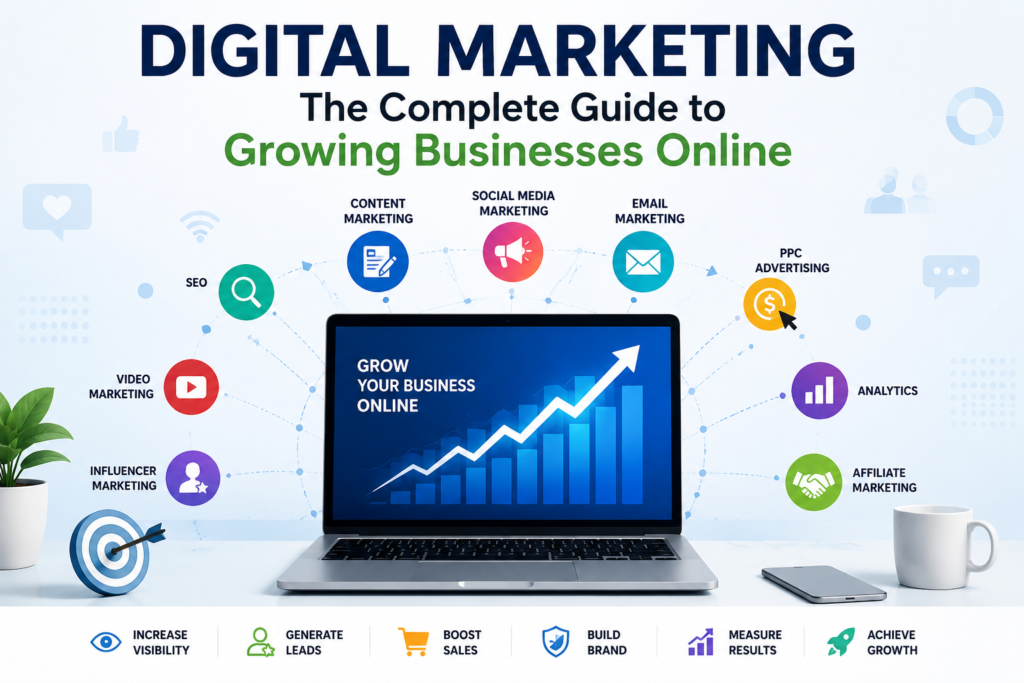
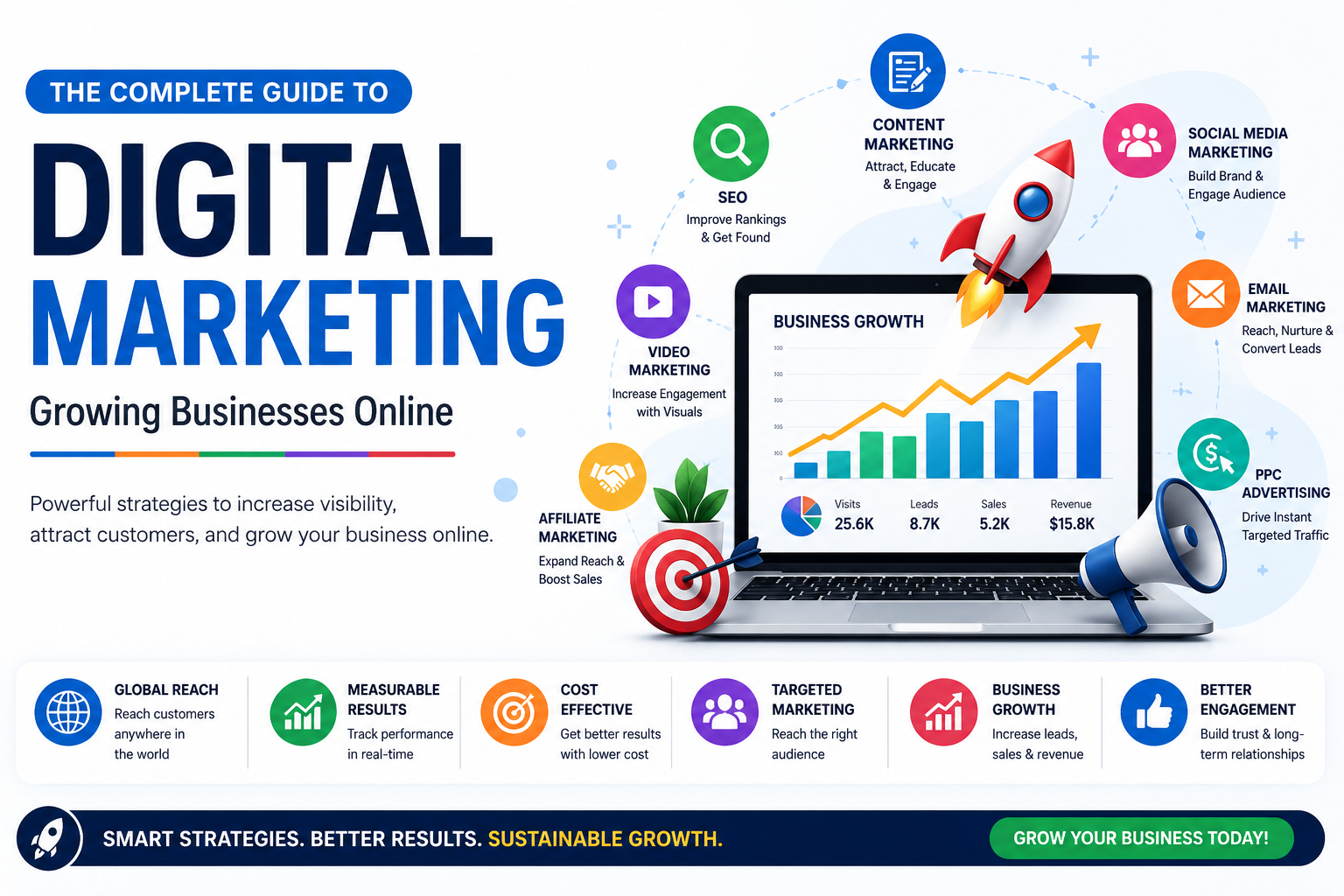
Digital marketing has transformed the way businesses connect with customers. Whether you own a small startup, an online store, or a multinational company, having a strong digital presence is no longer optional. It has become one of the most effective ways to build brand awareness, generate leads, increase sales, and maintain long-term customer relationships.
What is Digital Marketing?
Digital marketing refers to promoting products or services using online channels such as search engines, websites, social media platforms, email, mobile applications, and paid advertisements. Unlike traditional marketing, it allows businesses to target specific audiences, track performance in real time, and optimize campaigns for better results.
Instead of relying only on newspapers or television, companies now communicate directly with potential customers through digital platforms where billions of people spend their daily time.
Why Digital Marketing Matters
Businesses today compete in an environment where customers search online before making purchasing decisions. A strong digital presence helps organizations:
- Increase visibility
- Reach targeted audiences
- Generate qualified leads
- Improve customer engagement
- Build trust and credibility
- Measure campaign performance
- Reduce marketing costs
- Expand globally
Companies that ignore digital marketing often struggle to compete with businesses actively investing in online growth.
Core Components of Digital Marketing
| Component | Purpose | Main Goal |
|---|---|---|
| SEO | Improve search rankings | Organic traffic |
| Content Marketing | Share valuable information | Build authority |
| Social Media Marketing | Engage audiences | Brand awareness |
| Email Marketing | Direct communication | Customer retention |
| PPC Advertising | Paid promotion | Instant traffic |
| Affiliate Marketing | Partner promotion | Sales growth |
| Influencer Marketing | Creator collaboration | Trust building |
| Video Marketing | Visual storytelling | Engagement |
Search Engine Optimization (SEO)
SEO helps websites rank higher on search engines by improving content quality, technical structure, backlinks, and user experience.
Important SEO elements include:
- Keyword research
- On-page optimization
- Meta titles
- Meta descriptions
- Internal linking
- Site speed
- Mobile optimization
- Image optimization
- Schema markup
- High-quality backlinks
Good SEO creates long-term organic traffic without depending entirely on advertising budgets.
Content Marketing
Content is the foundation of digital marketing. Helpful articles, guides, videos, infographics, and tutorials educate customers while improving search visibility.
Popular content formats include:
- Blog posts
- Case studies
- White papers
- Tutorials
- Podcasts
- Videos
- Checklists
- Newsletters
High-quality content answers user questions instead of simply promoting products.
Social Media Marketing
Social media platforms help businesses build communities and engage directly with customers.
Common objectives include:
- Brand awareness
- Website traffic
- Customer support
- Product launches
- Community engagement
- Lead generation
Consistency matters more than posting randomly.
Email Marketing
Email remains one of the highest ROI marketing channels.
Benefits include:
- Personalized communication
- Automated sequences
- Customer retention
- Product updates
- Promotional campaigns
- Lead nurturing
Segmentation significantly improves campaign performance.
Pay-Per-Click Advertising (PPC)
Paid advertising delivers immediate visibility through search engines and social platforms.
Advantages include:
- Fast traffic
- Precise targeting
- Budget control
- Measurable results
- A/B testing opportunities
However, campaigns require continuous optimization to remain profitable.
Affiliate Marketing
Businesses reward partners for generating sales or leads through referral links.
Advantages:
- Performance-based spending
- Wider reach
- Lower upfront costs
- Scalable growth
Challenges include maintaining quality affiliates and preventing fraudulent activity.
Influencer Marketing
Creators with loyal audiences promote products authentically.
Effective influencer partnerships focus on:
- Audience relevance
- Authentic engagement
- Long-term collaboration
- Transparent disclosure
Micro-influencers often generate higher engagement than celebrity accounts.
Video Marketing
Videos simplify complex topics and increase audience retention.
Popular formats include:
- Tutorials
- Reviews
- Product demonstrations
- Testimonials
- Live sessions
- Behind-the-scenes content
Video content performs exceptionally well across multiple platforms.
Digital Marketing Funnel
| Stage | Customer Action | Marketing Goal |
|---|---|---|
| Awareness | Learns about brand | Visibility |
| Interest | Explores information | Engagement |
| Consideration | Compares options | Education |
| Decision | Makes purchase | Conversion |
| Retention | Returns again | Loyalty |
| Advocacy | Recommends brand | Referrals |
Benefits of Digital Marketing
1. Global Reach
Businesses can target customers across different countries without physical offices.
2. Cost Efficiency
Compared to traditional advertising, digital campaigns often require lower investment while offering measurable returns.
3. Measurable Results
Analytics tools track:
- Clicks
- Impressions
- Conversions
- Revenue
- Bounce rates
- User behavior
4. Better Targeting
Campaigns can focus on demographics, interests, devices, locations, and behaviors.
5. Real-Time Optimization
Businesses can modify campaigns immediately based on performance data.
6. Higher Customer Engagement
Interactive content strengthens customer relationships.
7. Scalability
Campaigns can expand with business growth.
Challenges of Digital Marketing
| Challenge | Explanation |
|---|---|
| High Competition | Many businesses compete for attention |
| Algorithm Changes | Rankings and reach can fluctuate |
| Content Saturation | Standing out becomes difficult |
| Rising Ad Costs | Paid campaigns may become expensive |
| Privacy Regulations | Data collection requires compliance |
| Constant Learning | Trends evolve rapidly |
Common Mistakes
- Ignoring SEO fundamentals
- Publishing poor-quality content
- Buying fake followers
- Neglecting analytics
- Inconsistent branding
- Overusing paid ads
- Forgetting mobile optimization
- Weak call-to-actions
- Slow website performance
- Poor audience research
Essential Digital Marketing Skills
Professionals should develop:
- Copywriting
- SEO knowledge
- Data analysis
- Graphic design basics
- Video editing
- Email automation
- Social media management
- Paid advertising
- Communication
- Strategic planning
Measuring Success
Key performance indicators include:
| Metric | Importance |
|---|---|
| Website Traffic | Audience growth |
| Conversion Rate | Sales effectiveness |
| Bounce Rate | User experience |
| CTR | Ad performance |
| ROI | Financial return |
| CPA | Acquisition cost |
| Customer Lifetime Value | Long-term profitability |
Best Practices
- Focus on user intent
- Publish consistently
- Optimize for mobile devices
- Improve page speed
- Build quality backlinks
- Test campaigns regularly
- Analyze performance weekly
- Update outdated content
- Maintain branding consistency
- Prioritize customer experience
Future Direction of Digital Marketing
Technology continues reshaping digital marketing through automation, personalization, predictive analytics, conversational interfaces, advanced data analysis, and intelligent recommendation systems.
Businesses that adapt quickly gain competitive advantages while improving efficiency and customer satisfaction.
Privacy-focused marketing and first-party data collection are becoming increasingly important as regulations evolve.
Small Business Guidance
Small businesses should prioritize:
- Professional website
- Local SEO
- Google Business optimization
- Regular blogging
- Email collection
- Social media engagement
- Video content
- Customer reviews
- Analytics monitoring
- Consistent branding
Enterprise-Level Strategy
Large organizations benefit from:
- Marketing automation
- CRM integration
- Multi-channel campaigns
- Attribution modeling
- Data-driven personalization
- Advanced audience segmentation
- Predictive analytics
- Global SEO strategies
Frequently Asked Questions
Is digital marketing suitable for beginners?
Yes. Anyone willing to learn fundamentals and practice consistently can build valuable skills.
Does SEO take time?
Yes. Organic growth usually develops gradually but often produces sustainable long-term results.
Is paid advertising necessary?
Not always. Many businesses grow successfully through SEO and content marketing, although paid campaigns can accelerate visibility.
Which channel delivers the best ROI?
The answer depends on business type, audience, goals, and execution. Email marketing and SEO often provide excellent long-term returns.
Can small businesses compete with large brands?
Yes. Niche targeting, quality content, and customer relationships allow smaller companies to compete effectively.
Final Thoughts
Digital marketing is not simply about promoting products online—it is about understanding audiences, delivering value, building trust, and creating measurable business growth. Organizations that combine quality content, search optimization, social engagement, email communication, analytics, and continuous improvement establish stronger competitive positions and achieve sustainable success over time.
Success comes from consistency, strategic planning, data-driven decisions, and adapting to changing technologies rather than relying on short-term tactics.